



The Foundation is working on the translation of “Das P-Prinzip”
+++ Translation of Herbert W. Franke’s book on natural philosophy, Das P-Prinzip has begun
+++ Third volume of the Edition Herbert W. Franke now in preparation at Deutscher Kunstverlag
+++ Co-financing of the project by Ragnar Digital Art Collection through the purchase of works
Ragnar Digital Art Collection recently opened its online doors. It is dedicated to the preservation, curation, and promotion of computer art from the 1950s till today. In 2025, as part of an expansion of the physical collection, Ragnar Digital acquired three generative works from the Foundation Herbert W. Franke, which further complemented the existing collection of Franke’s works.
We would like to express our sincere thanks to Ragnar Digital for this purchase, and we are proud to be part of this important collection. We have used the proceeds to fund the English translation of Das P-Prinzip (1995), in which ‘P’ stands for the ‘universal program’. It will be part of the scientifically annotated Edition Herbert W. Franke and will be published in English for the first time, alongside other books by Franke. The book is currently being compiled by Susanne Päch as editor and will be published in collaboration of Deutscher Kunstverlag and the Foundation. The first two volumes are already announced, Kunst und Konstruktion/Art and Construction (1957) and Computergrafik – Computerkunst/Computer Graphics – Computer Art (1972), will be published in 2026. Foundation founder Susanne Päch said: “In my view, Das P-Prinzip is Herbert’s most important literary work, even if it has not become particularly well known. It is his intellecual legacy reflecting his comprehensive natural-philosophical conception of the universe, humankind and the world we live in with all our desires and hopes, as well as the human thirst for knowledge and its limitations.”

Prof. Dr. Imre Koncsik, dogmatist and systems theorist, has already completed a scientific commentary on the book. In it, he summarizes Franke as a pioneer of algorithmic naturalism. Franke describes the elements of our universe that are relevant to him. First: the initial conditions, including universal constants. Second: the laws of nature governing evolutionary processes in the cosmos. However, according to Franke, this does not fully describe the universe. Thirdly, the initial conditions and the laws of nature must be embedded in a higher-level system in which, in addition to the algorithms of the laws of nature, a teleological principle with increasing complexity is also defined. He thus ties in with ideas published by the great computer pioneer Konrad Zuse in Der Rechnende Raum (The Calculating Space) in the 1960s.
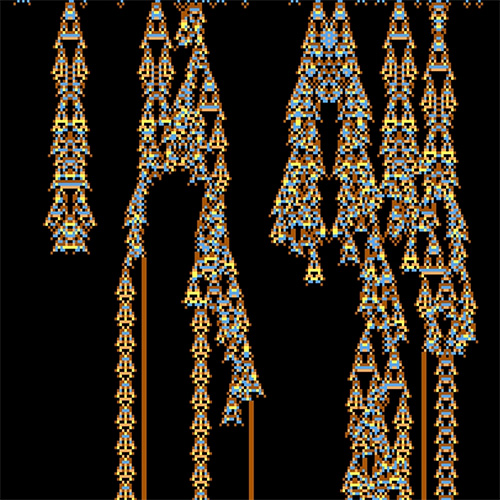
Beginning of the 1990s, Franke investigated the influence of true randomness in our world, also using visualised codes. He developed varying abstract models of the world based on the mathematics of one-dimensional cellular automata, a concept that was not discovered by Stephen Wolfram until the 1980s. Franke presents the insights gained from these experiments in this book. He was convinced that our universe is influenced by ‘true’ chance through the quantum processes underlying everything, and that as a result, the future cannot be predicted with certainty.
The ideas expressed in Das P-Prinzip meander between physics and metaphysics, with Franke remaining true to two principles of life: first, to always stay on the path of science—and second, where scientific knowledge ends and metaphysics begins, not to fall into the dogma of one’s own convictions, but to open up models of thought for discussion.
However, this does not mean that he did not wrestle with such questions. Instead, Franke turned to art — literature, in this case. This enabled him to translate his abstract imaginative worlds into tangible spaces and actions. In numerous novels and stories, he transformed the metaphysical ideas of the Principle P into possible models of reality. Although Franke did not believe in the possibility of predicting the future, he nevertheless thought that people could influence future developments through their actions. Through his utopian models of the future, Franke aimed to stimulate thought and actively contribute to shaping our future. Hans Esselborn will be contributing to Herbert’s science fiction from a literary perspective.
The foundation is currently transforming three of Franke’s short stories on the theme of the P principle into multimedia presentations for planetarium fulldomes.