



Important books, many in English for the first time, published by DKV and the Foundation
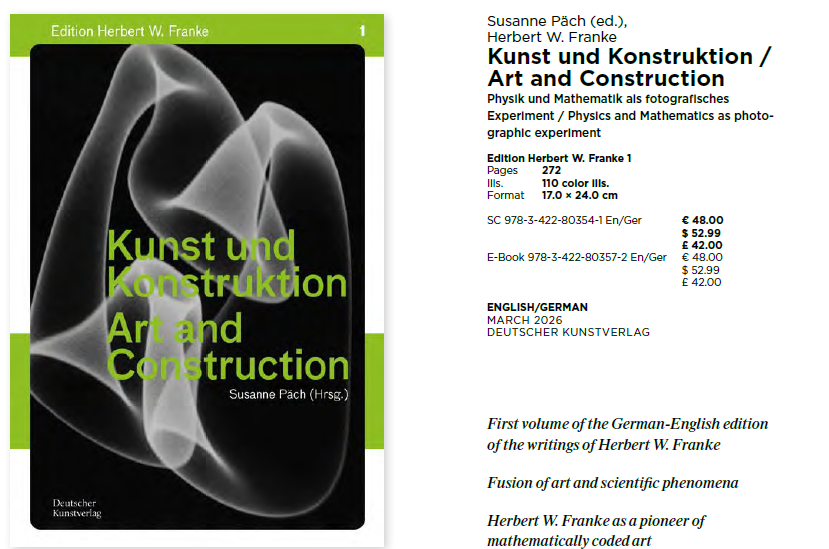
+++ Volume 1: Kunst und Konstruktion /Art and Construction
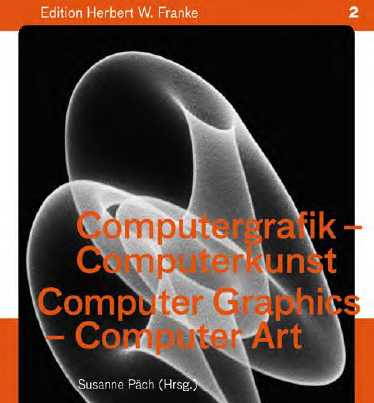
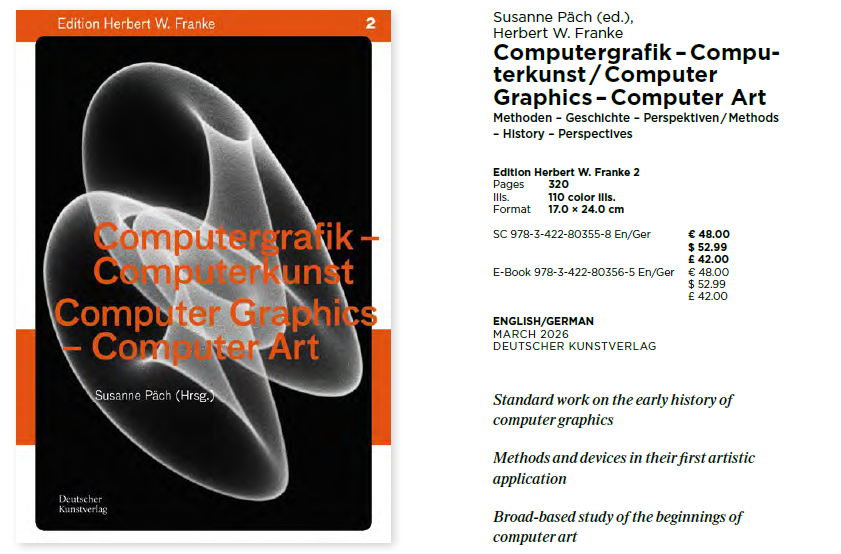
+++ Volume 2: Computergrafik – Computerkunst / Computer Graphics – Computer Art
+++ with supplementary articles by Franke from the ZKM manuscript database, translated into English for the first time
+++ including scientific commentaries, including those by Margit Rosen and Grant D. Taylor
The Basic Concept of the Edition Herbert W. Fanke
Each volume of the edition consists of Franke’s main work, supplemented by around 10 articles by Franke, translated into English. They are part of the 2000 manuscripts that are already published online in German in the ZKM Herbert W. Franke Archive. These articles show his view on specific aspects of the respective edition and make direct references to the other works in the edition. At least two authors comment on the volumes and their author as a bridge builder between science and art from different perspectives. These scholarly contributions, like the supplementary articles, appear only in English, while the main text of the original book is bilingual. All volumes are richly illustrated, with editor Susanne Päch drawing on the original image material as far as possible. The first pre-sale has now taken place, the final publication date spring 2027 has not yet been set.
Scientific Comments Edition Volume 1: Kunst und Konstruktion /Art and Construction

The art historian Margit Rosen, head of the ZKM department Knowledge – Collections, Archives and Research, examines in her article the significance of the book Art and Construction, which has largely been forgotten over the decades. In her view, it was a pioneering work of modern art theory in 1957. Rosen also highlights Franke’s role in relation to contemporary art trends. She states: “At a time when algorithmic processes and artificial intelligence seem to redefine our understanding of creativity, Franke’s assertion of the ‘artistic substance of technology’ acquires a prophetic resonance.” Rosen explains his view that analytical thinking is relevant not only for the production but also for the reception of art. Shortly thereafter, this led Franke to his information and perception theory considerations of a rational art model, which was first published in 1967 with Phänomen Kunst (Phenomenon Art). It will be also part of this edition.

In the second scientific contribution to the volume, quantum physicist and computer artist Eric de Giuli focuses primarily on deriving the mathematical aesthetic laws presented by Franke as an educated theoretical physicist. He studied them in mathematical detail through his artistic experiments, which demonstrate Franke’s strong connection to the scientific approach to creating art: “In Art and Construction, Franke worked with minimalist compositions derived from transparent processes … so the aesthetic effect could be traced back to their laws. This led him to his key concept: continuity.” Later, Franke equated continuity with symmetry in aesthetics and suggested that the principle of smooth curves, i.e. continuity, had not become as well known in the art world due to its mathematical complexity.
Scientific Comments Edition Volume 2: Computerkunst / Computer Graphics – Computer Art

The media art historian Grand D. Taylor decribes the book in his article as „a groundbreaking achievement, a pioneering survey, and a lasting testament to the creative possibilities of emerging technologies“. Taylor emphasizes the enduring nature of Computer Graphics – Computer Art , which remains relevant to generative art to this day, when he writes: “Over the decades, it has been included in all primary selected bibliographies, firmly establishing its canonical status. However, its significance goes beyond its role as a foundational reference. … Franke’s vision has significantly contributed to the definition of the field, and his legacy continues to influence our comprehension of the dynamic interplay among the realms of art, science, and technology.“

In the second scientific contribution to the volume, the computer scientist Martin Warnke says about Franke’s book: „It was the first comprehensive monograph on the subject at a time when artistic practices and theoretical work on art with and from the computer were just beginning.“ Warnke takes a look at the early days of computer graphics—computer art, in which artists working with the newly emerging technical methods of computer graphics found no interest in the conventional art world. He also contextualizes the book’s significance in the current landscape: „Franke’s theories and observations from that time could provide explanatory approaches for today.“