



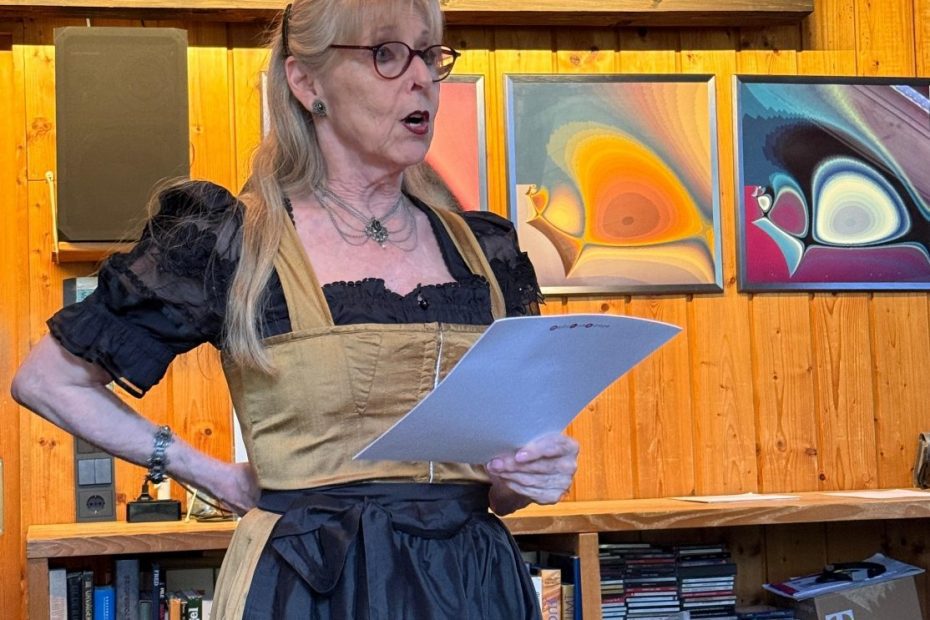
Edition Franke – Opening of the Herbert W. Franke Lab – Immersive Sci Fi
The year 2025 is drawing to a close. This is a welcome opportunity for the Foundation Herbert W. Fanke to look back on the past months and review the highlights.
Launch preparations Edition Herbert W. Franke
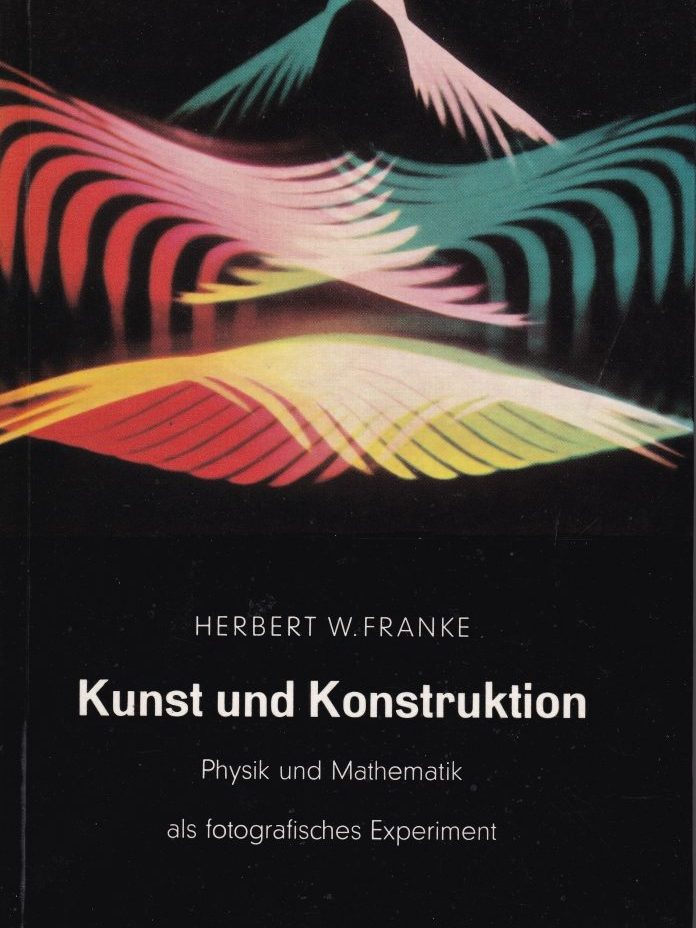
The most extensive and significant project this year and in the coming years is the Edition Herbert W. Franke, which will publish seven of Franke’s most important specialist and non-fiction books. The series will be published internationally in print and as eBooks in collaboration with Deutscher Kunstverlag. Most of these books will be available in English translation for the first time. The editorial work on Art and Construction: Mathematics and Physics as Artistic Experiment from 1957 (Volume 1) and the first edition (1971) of Computer Graphics – Computer Art: Methods – History – Theory (Volume 2) has now been completed by Susanne Päch, foundation director and editor of the edition.
At this point, the foundation would like to thank the community of generative artists who contributed to the financing of the first two volumes by purchasing an edition of the ZENTRUM code, which was re-constructed for the blockchain, in November 2023 by Aaron Penne.
Each of the richly illustrated volumes consists of three modules: the bilingual original text of the work, supplementary specialist and popular science articles by Franke on related issues (the German articles are already publicly available online in the manuscript database of the Herbert W. Franke Archive at the ZKM), and commentary on the classification of the work by two scientists from different academic disciplines.
Univerity of Innsbruck: opening of the Herbert W. Franke Lab
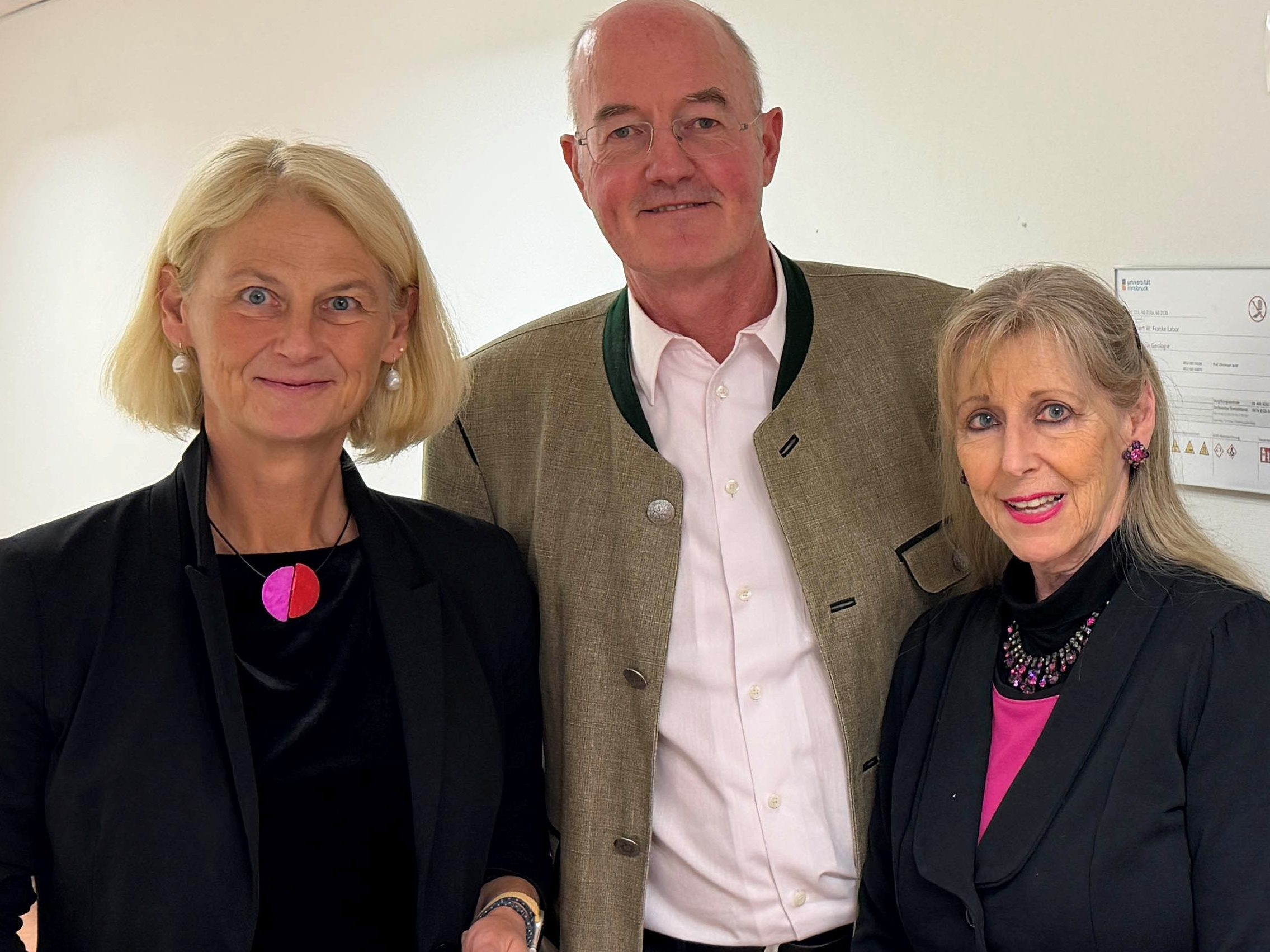
In October 2025, a new clean room laboratory was inaugurated at the Geological Institute of the University of Innsbruck in a festive ceremony. The Herbert W. Franke Laboratory, which also houses a state-of-the-art multi-collector ICP mass spectrometer, will now make it possible to determine the frequencies of rare isotopes with exceptional precision—a key technology for dating geological samples and reconstructing past environmental conditions, known as paleoclimate. It is named in honor of Herbert W. Franke, who was one of the first people in the world to study the age determination of stalactites and stalagmites, thereby laying the foundation for using cave deposits as valuable archives of climate history. “Herbert W. Franke, a pioneer and visionary, remains a lasting role model, because only precise age determination provides the key to learning from the Earth’s past,” says Univ.-Prof. Dr. Christoph Spötl, Dean of the Faculty of Geo- and Atmospheric Sciences at the University of Innsbruck and founder of the Innsbruck Quaternary Research Group. More information on the scientific aspects of age research with speleothems can be found here (in German only).
NANOX – an oligarch rules the world
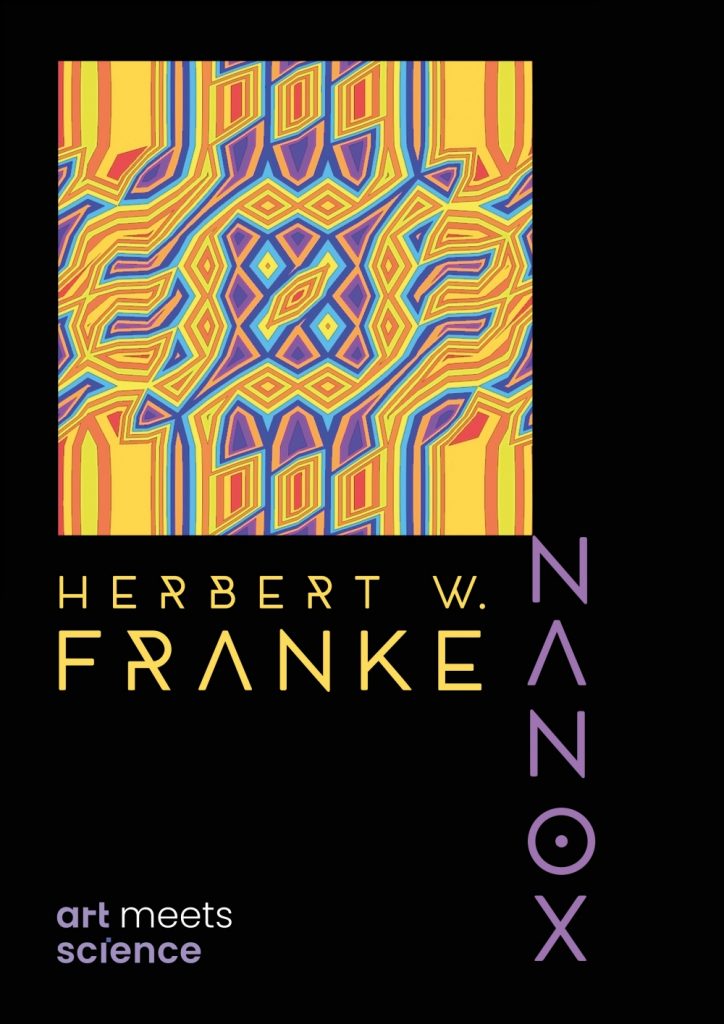
Herbert W. Franke is also considered a famous pioneer of post-war German-language science fiction. All of his published novels, short stories, and radio plays have already been included in the collected works. However, his previously unpublished late work NANOX, conceived in 2013, remained unfinished. Franke wanted to draw attention to social changes that were already becoming apparent at the time: globally active entrepreneurs who want to rule the world with their innovations – in this case, thanks to future nanotechnologies and digital neuromanipulation. These are topics that are more relevant today than ever. Franke planned to have the film scenes of a screenwriter described in the novel, which play an important role in the story, realized not in text form but in collaboration with a graphic designer as a storyboard: a plan that Franke was unable to implement. More information on Franke’s idea of inserting graphic novel passages can be found in the supplementary section of the book, as well as a detailed literary commentary by co-editor and literary scholar Prof. Hans Esselborn. The editor presents Franke’s conceptual considerations on the as yet unresolved outcome of the plot.
The first Meeting of the Foundation’s Board of Trustees
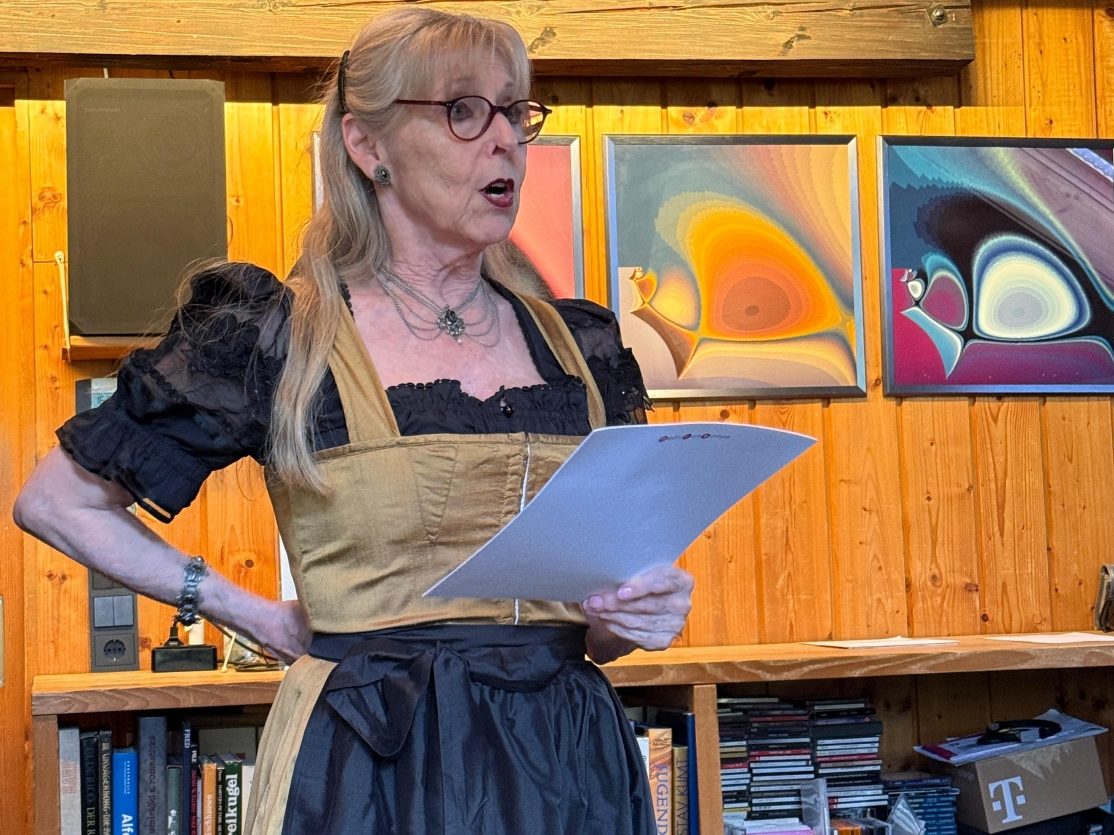
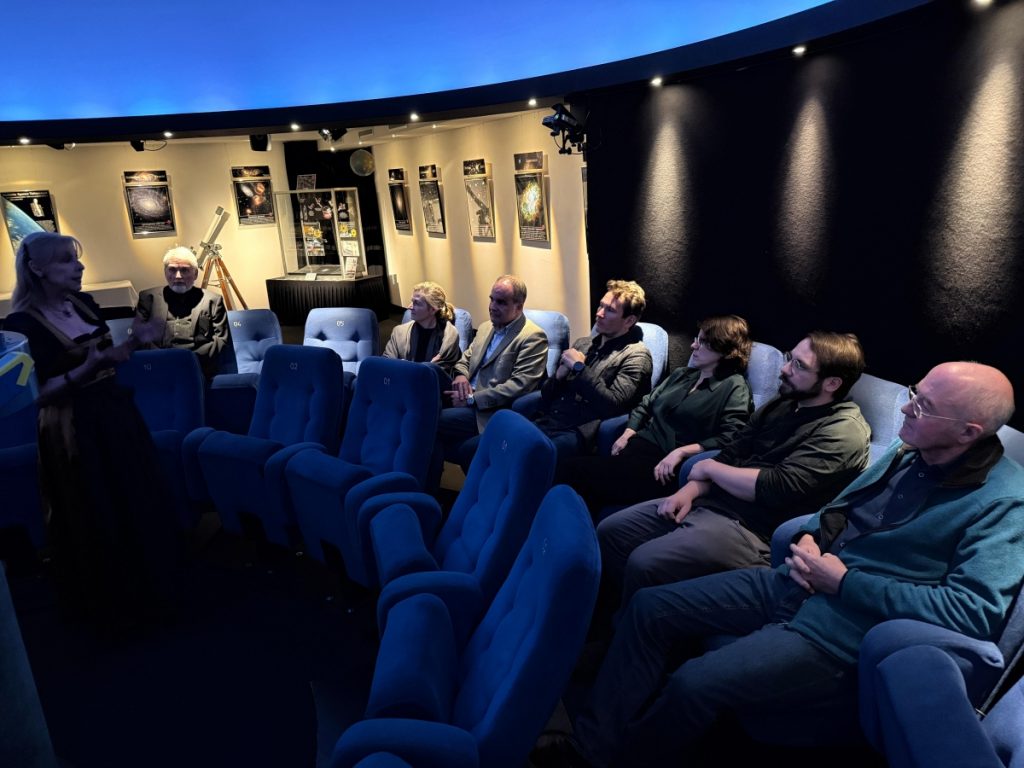
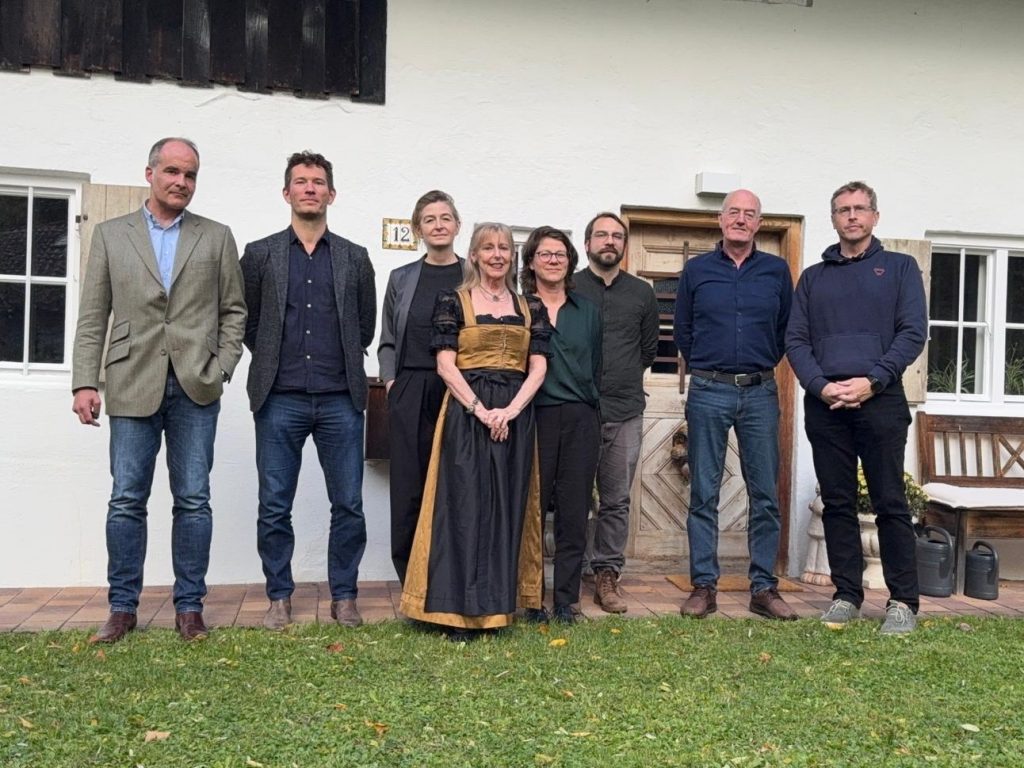
A particular highlight for the foundation was the first board of trustees meeting, which took place in October 2025. Participants included Margit Rosen, Prof. Dr. Christoph Spötl, Manuel Gerber, Markus Michalek, and Felix Mittelberger, the two directors of the foundation, Susanne Päch and Constantin Päch, as well as foundation employee Dorothea Schroeder. The workshop ended at the Bad Tölz Planetarium with an internal evening screening of three visually distinct pilot productions featuring readings from three science fiction stories penned by Herbert W. Franke. These pave the way for a new area of publication for the foundation in 2026. More on this in the following section.
Science Fiction under an Immersive Dome
The foundation selected three of Franke’s approximately 200 stories to be developed into pilot projects for immersive implementation in collaboration with co-producer mce mediacomeurope GmbH. All three productions will be narrated in a German and in an English version. The plots revolve around ideas about the evolution of the universe and the meaning of intelligence: in other words, the really big questions facing humanity. The foundation commissioned Sergey Prokofyev, a star among immersive artists, to bring ne of the stories, A Leap into the Void, to life. Read more about A Leap into the Void in our news section.
The super-short title story of the anthology Der grüne Komet (The Green Comet, 1960) is unusual as Franke completely dispenses with human characters in his narrative about the end of the world. In Das Evolutionsspiel (The Evolution Game, 1995), Franke takes us to a scientific astrophysics lab where a research nerd presents a new simulation for a universe, including a model for the emergence of intelligent life—an activity that, however, has a highly surprising side effect. The plot of Der Sprung ins Nichts (A Leap into the Void, 1995), the third short story by Franke, who was described by the FAZ as a “short story pyrotechnician”: A prophet encourages people to jump into a fog-shrouded abyss. His message: “You will fly! You just have to believe!” Frederik is one of them. But despite the prophet’s convincing message, Frederik remains filled with doubts and resists until the surprising end of the story.

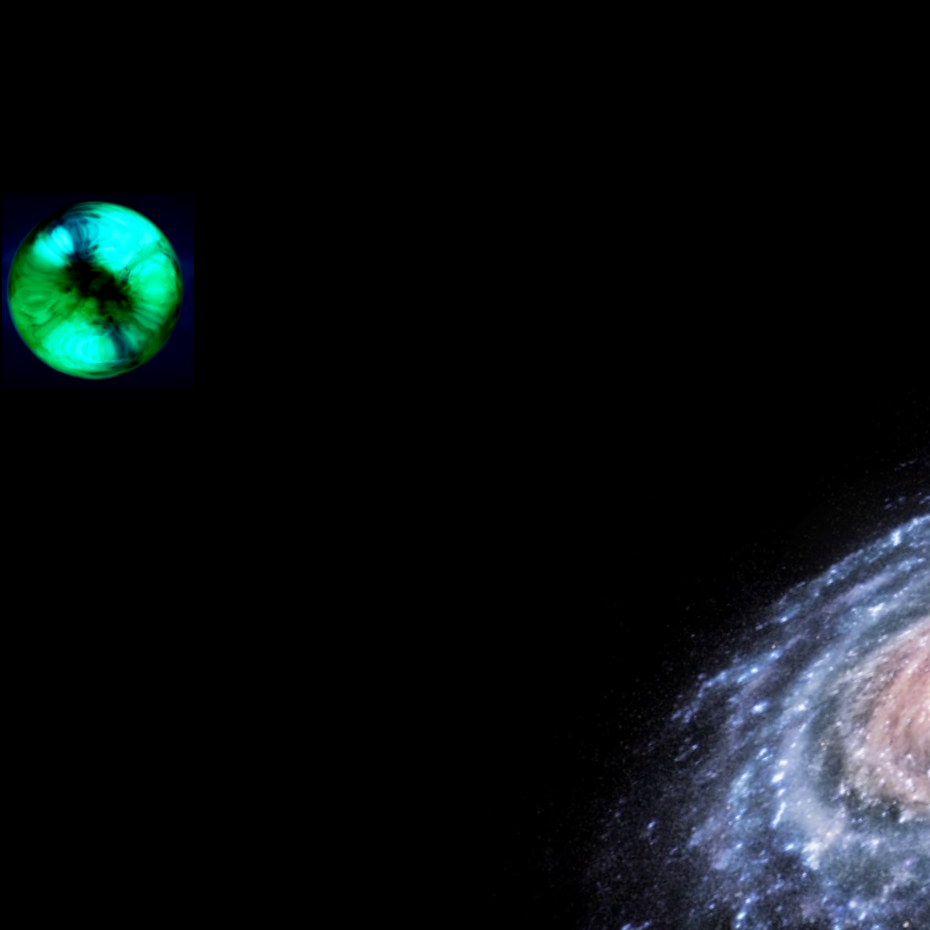
The three stories will be presented to the public at several events next year, including Glowing Globe in Rijeka. The foundation will also present a paper on Edutainment for the Dome: Three Different Multimedia Realizations of Narrated Sci-Fi Stories at the biennial congress of the International Planetarium Society (IPS). The event will take place in June 2026 in Fukuoka, Japan.
Launch of HWF 100
In 2027, the Foundation Herbert W. Franke will celebrate its 100th anniversary. The initial organizational work has already begun, as the goal is to hold several events at international locations. The preparation of the HWF 100 project will be a focal point of activities in 2026. The countdown to the project will begin with an exhibition at the Museum Folkwang in October 2026, which will end on January 6, 2027, by heralding the anniversary year. More information in our news.
Seasons’s Greetings and Happy New Year to all of you from the foundation Herbert W. Franke.