




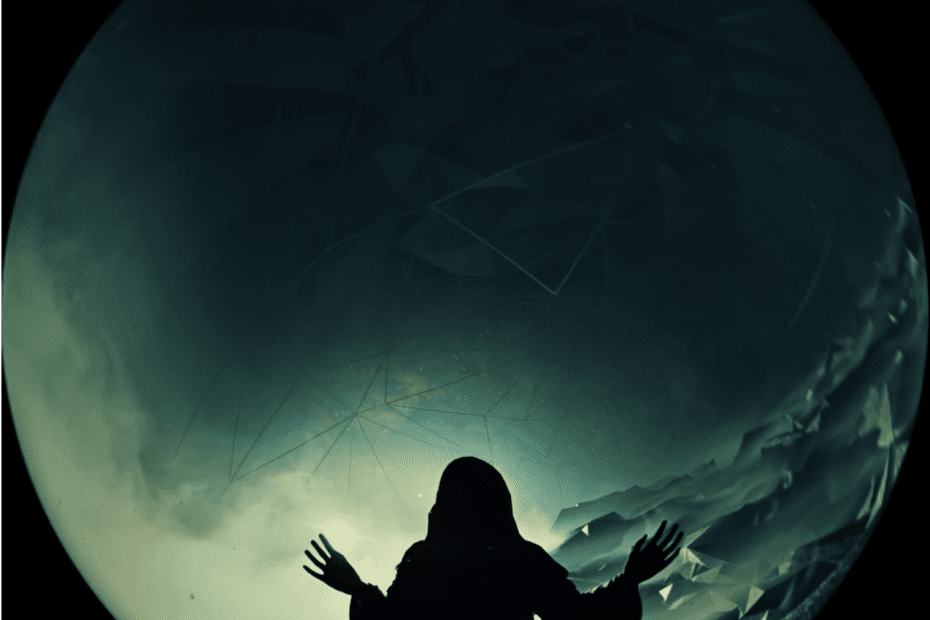
An immersive Sci-Fi Story by Herbert W. Franke for Planetariums
The multimedia production A Leap into the Void, directed by Sergey Prokofyev and based on a science fiction story by Herbert W. Franke, will have its world premiere on June 19 this year at the Fulldome Festival in the planetarium of the Fukuoka Science Museum. A first excerpt was already shown as a preview in April at the American Fulldome Festival, Dome Fest West. The immersive short film, produced by the Herbert W. Franke Foundation in collaboration with mce mediacomeurope GmbH, is based on Franke’s science fiction short story Sprung ins Nichts, translated by Stephen Lyle and narrated by Eric G. Ash.
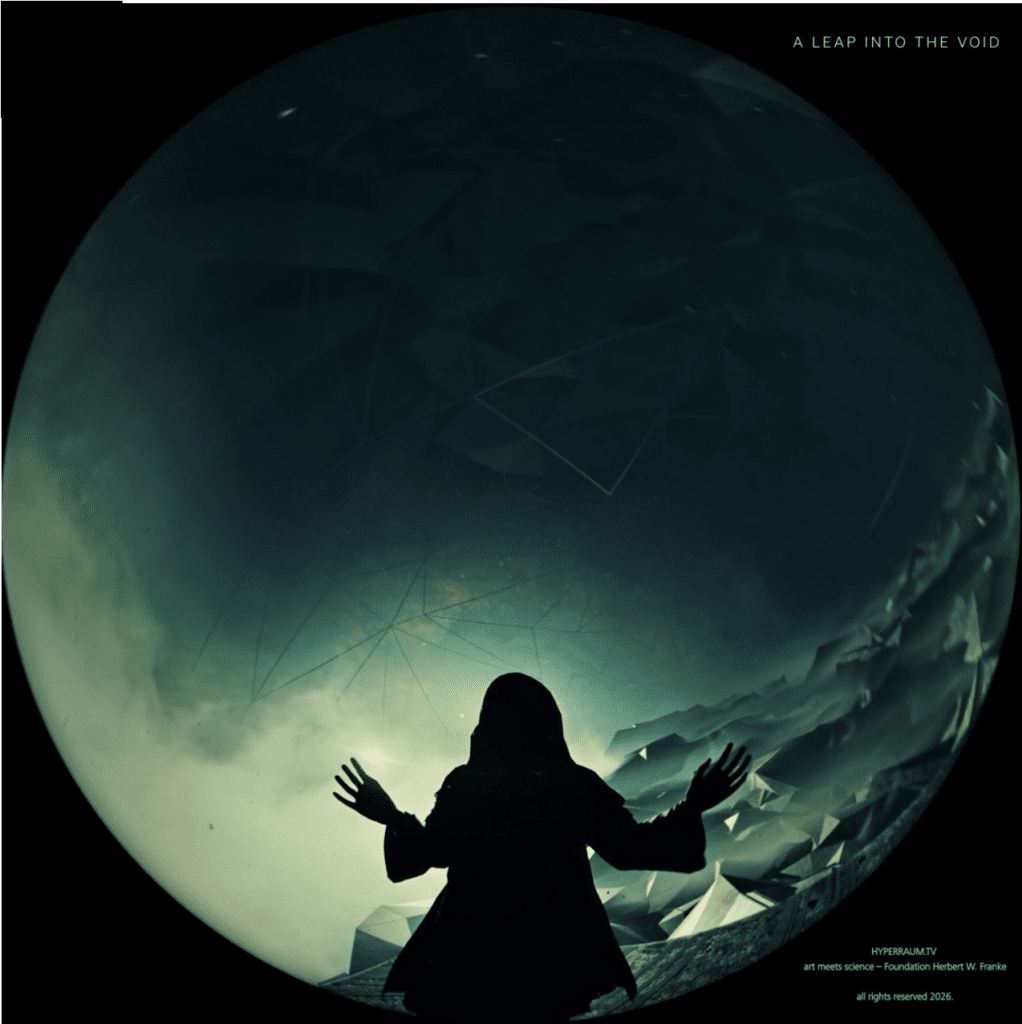
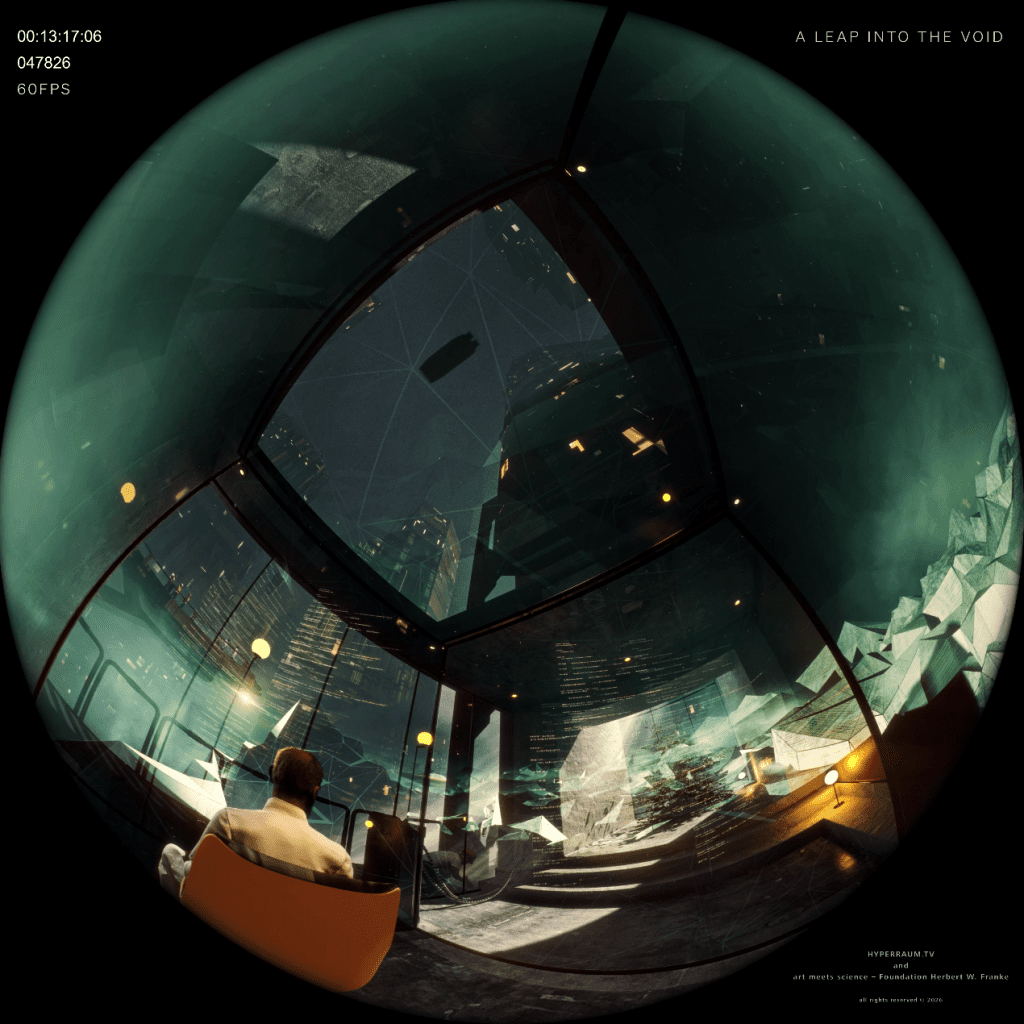
At the World Congress of the International Planetarium Society (IPS), which takes place every two years and this year immediately following the Fulldome Festival in Fukuoka, the Foundation Herbert W. Franke has the great honor of presenting a short lecture in the Content Production and Technology session. In addition to A Leap into the Void, Susanne Paech will show the other two productions featuring readings of Franke’s stories—a science fiction cycle in which the author, long a science fiction classic, grapples with humanity’s big questions: Is there a creator? And does the evolution of the cosmos have a purpose? In A Leap into the Void, Frederik, the protagonist of the story, is in the throes of an inner conflict. A prophet encourages a group of people to jump into a fog-shrouded abyss. His message: “You will fly! You just have to believe in it!” But Frederik does not want to jump, until the secret of his existence is revealed in a dramatic twist. In The Green Comet, the title story of the anthology of the same name, the author presents the creator of worlds as a multidimensional abstract principle. And in The Evolution Game, Franke depicts a divine being who could be described as a kind of world programmer.

These three science fiction stories are closely linked to Franke’s natur philosophic vie of the world. In his 1995 academic book The P-Principle. The Laws of Nature in Computational Space, the theoreticalphysicist with a Ph.D. presents his reflections on a “programmed” universe analogous to a cellular automaton. They are based on the latest research findings at the time regarding emergence, synergetics, chaos theory, systems theory, and cosmology. For Franke, chaos and order are embedded in a higher-level structure in which the universe evolves with increasing complexity until the emergence of life and intelligence. The book will be published in the Edition Herbert W. Franke, which is currently being implemented by the Foundation in collaboration with Deutscher Kunstverlag, part of the DeGruyterBrill Group.