




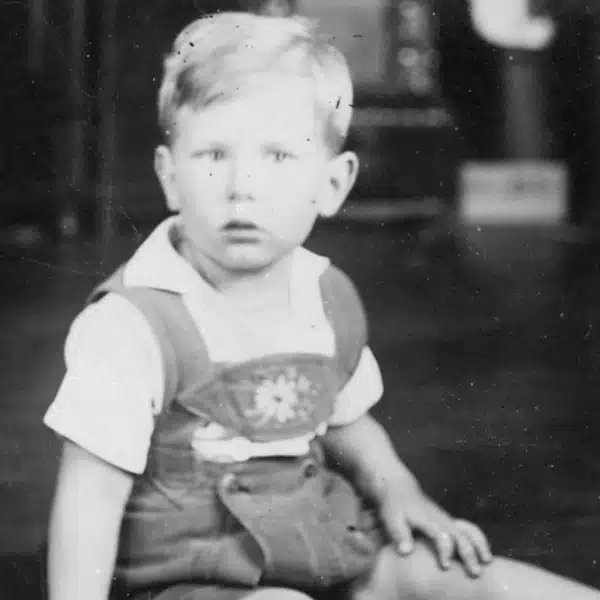
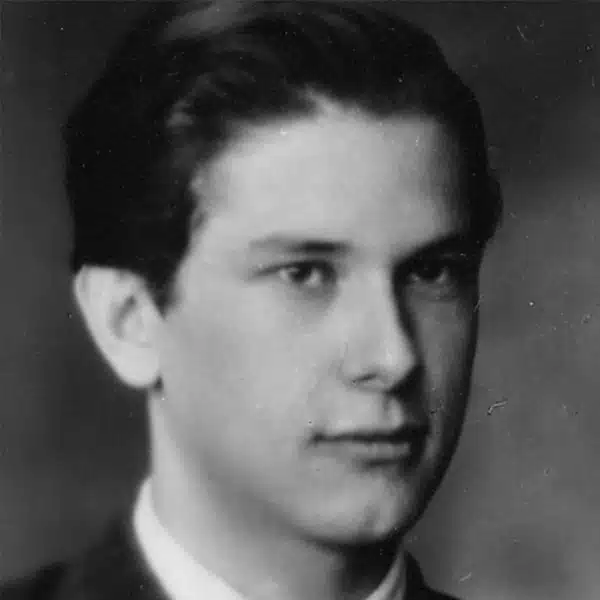
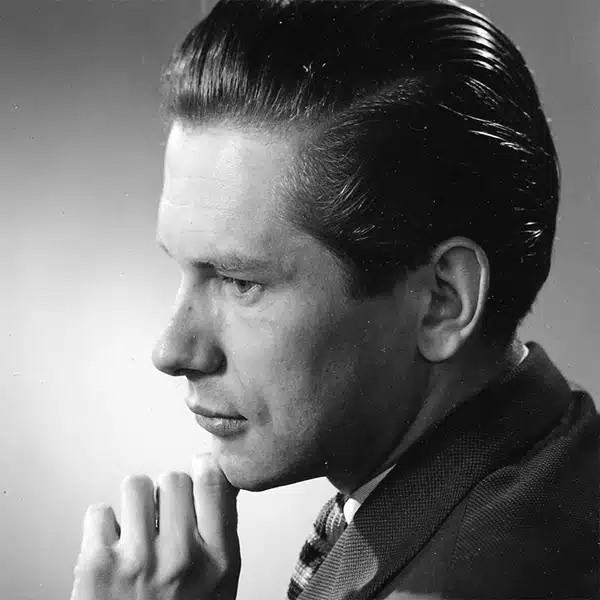
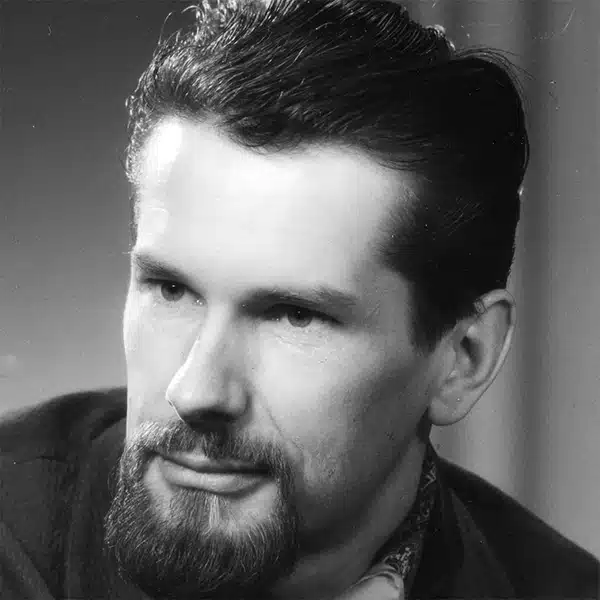
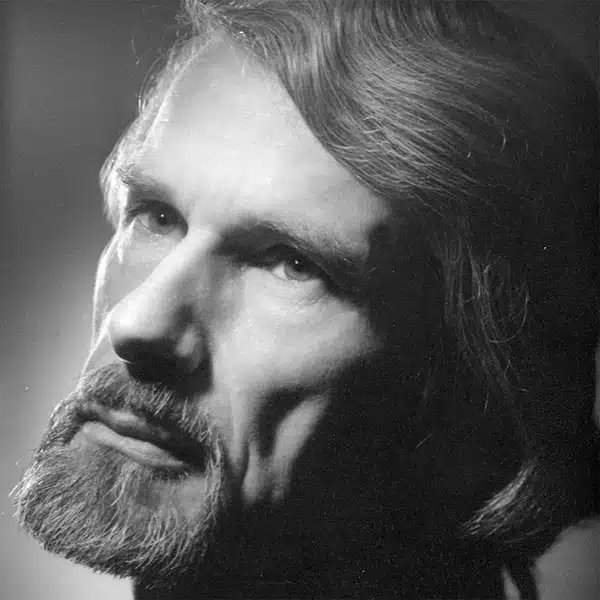
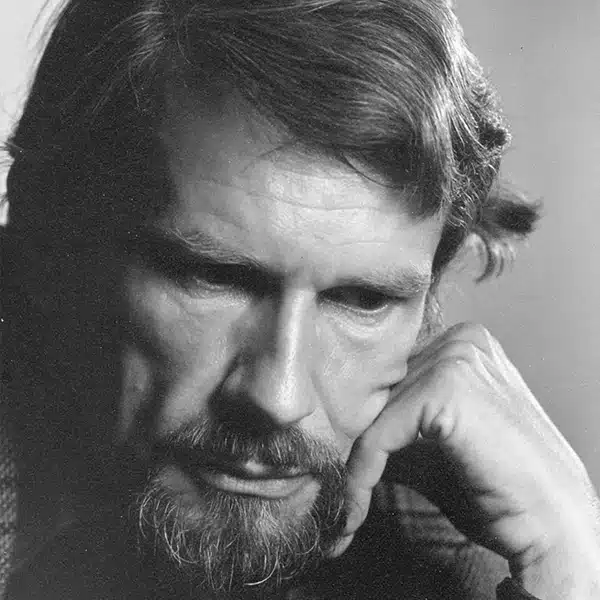
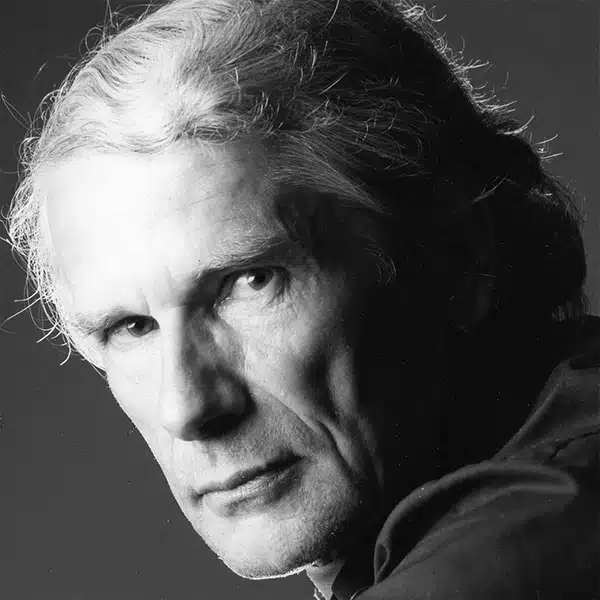
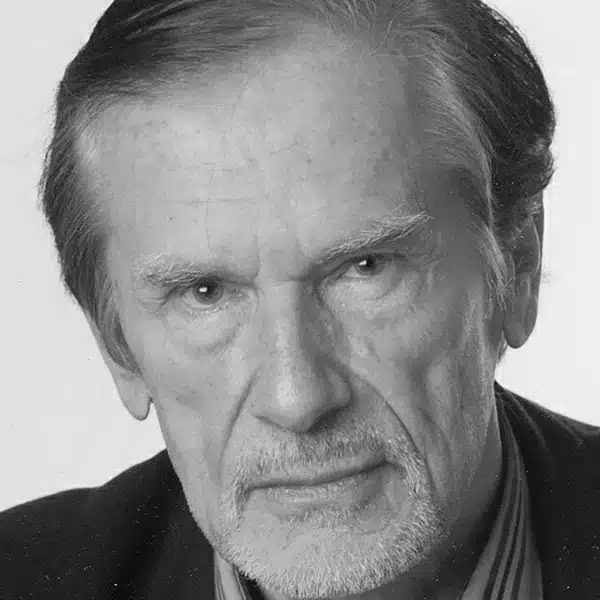
on the occasion of the 100th birthday
The Fusion of Poetry and Generative Art: Celebrating a Visionary

Poem 1
Destination unknown
solar sails wide unfurled
riding on the ion beam
a safe haven: far beyond space and time
Ice crystals formed within the cells
the veins devoid of blood
the memory deleted
the entire past extinguished
Being – between dream and death
is there an awakening?
is there any hope?
Ahead: Clouds and cosmic dust
behind them perhaps
a vast galaxy
star systems, and suns
planets, that are bathed in the warmth of clear light –
A taped wake-up call:
new lands!
behind it perhaps:
a void
This is how ASTROPOETICON begins: 16 space poems by Herbert W. Franke written in 1979. They explore the physical laws governing the cosmos and the evolutionary processes within it, culminating in the emergence of intelligence and the meaning of life. The foundation launched a multimedia project as a special tribute to Herbert W. Franke. It is based on a cycle of these sixteen poems that Herbert W. Franke wrote in 1979 for an art book showing works by the space artist Andreas Nottebohm. The poems were now translated into English by James Ginzburg and narrated by Eric Ash in a studio recording. The foundation invited generative artists from three continents. Each artist transformed one of the spoken poems into an immersive multimedia world honoring the 100th birthday of the visionary.
The multifaceted artworksfrom three continents required a distinct dramaturgy, which was conceptualized by Susanne Päch. The ASTROPOETICON 2027 unfolds Franke’s lyrical reflections on the cosmos between two poems that function as antipodes: The Prologue: HUBRIS depicts the world of anthropocentric view inherent to homo sapiens, while the Epilogue: TRANSLUCENCE reveals the infinite cosmos as an ontological totality. Between them, the remaining poems are arranged in three distinct blocks: GENESIS, CONTACT and INTELLIGENCE.
Joshua Davis (USA)
Joshua is an American pioneer of generative art and creative coding. Since the mid-1990s, he has used algorithms and code to create complex visual artworks. He programs his own algorithms, often using Processing or Flash, which employ mathematical rules to generate dynamic abstractions and interactive multimedia works. Through his film studio, he has also designed visuals and stage designs for artists such as Taylor Swift, Kanye West, Tool and the Red Hot Chili Peppers. I am honored that he is part of the project.
Joshua’s statement: I started writing code to make art back in 1994. At the time I had no idea if others pioneered this way of thinking. So, I started doing my due diligence and was thrilled to find all the people like Herbert before me who were paving the way for us to express ourselves this way. I am not only truly grateful but also humbled to be part of this collaboration ASTROPOETICON.
Weidi Zhang (China/USA)
Weidi holds a Ph.D. in Media Arts and Technology. She is a new media artist and designer based in Los Angeles and Phoenix. She is a tenure-track Assistant Professor of Immersive Experience Design at the Media and Immersice eXperience Center at Arizona State University. Her interdisciplinary research explores a speculative assemblage of artificial memories and language at the intersection of immersive media design, experimental data visualization, and interactive AI art. Her work has received widespread international recognition, earning distinctions such as the Best in Show Award(s) at ACM SIGGRAPH (2021, 2022), IF Design Award (2026), the Red Dot Design Award (2022). Her work has been featured at major global institutions and festivals.
Weidi’s statement: I would be very happy to be part of the ASTROPOETICON community project. The project strongly aligns with my research, especially my ongoing work in fulldome immersive environments and my exploration of the intersection of science fiction, interactive generative art, and computational art.
I am also a great admirer of Herbert W. Franke. His unique position across science, speculative fiction, and early computer art has been deeply inspiring to me.
Mario Carrillo (Mexico) / Finn Streuper (The Netherlands)
Mario is a Mexican artist working with code to create moving images that explore states of perception. He is interested in how we interpret information through compositions that combine geometry, organic forms, color, motion and rhythm. His practice uses computation as a form of expression, engaging with technology through an experimental and creative approach. His work can be classified as both computer art and Op Art. Carrillo’s visual art has been presented across America, Europe, and Asia, including at institutions and festivals such as the Barbican Centre, Salzburg Easter Festival, and DOK Leipzig.
Finn Streuper is a composer and producer whose work explores the boundaries between acoustic instrumentation and digital sounds. Rather than following a clear narrative, he creates music that feels like an environment to inhabit, drawing from spiritual jazz, warm library sounds, and surreal digital textures.

Mario’s statement: Being invited to participate in ASTROPOETICON for Herbert W. Franke’s 100th birthday is both an honor and deeply meaningful to me, as it fosters a sense of connection to one of the great pioneers who shaped the foundations of computer art. The project stands as a testament to how artists from around the world can converge, bringing diverse perspectives to reinterpret Franke’s literary work. I am particularly excited to engage with his poetry and create a piece that reflects and honors his legacy. Foremost, I would like to express my gratitude to the Herbert W. Franke Foundation and Susanne Päch for their continued dedication to preserving and celebrating his contributions to the field.
Poem No. 3: “Traces” reflects on the constant, never-ending search for knowledge. The visual for the poem is an abstraction to represent that through traces of light and color traveling through a radial maze, changing course until they find the origin — the cause, the source. Once there, realizing there are only more questions that loop back to the beginning of the process, the poem repeats this metaphor three times, each repetition expanding before finishing in a void, an eye that dissolves into darkness.
Poem No. 5: “The Law of the Cosmos” is a meditation on the universe, unfolding a macrocosm of geometry and sound across three unique chapters that evoke an elusive and surreal experience.
Saeko Ehara (Japan)
Saeko is a Tokyo-based Japanese artist whose practice centers on the aesthetics and emotional resonance of “Kirakira.” It describes an aesthetic characterized by brilliance. It is deeply rooted in Japanese pop culture. Inspired by childhood memories of collecting shimmering objects and immersive moments of play, her work reflects a sense of wonder and timelessness. Saeko works with AI and generative art, she explores a balance between human intention and algorithmic autonomy, allowing systems to shape the final expression. She has exhibited internationally in digital art contexts and aims to expand Kirakira Art as a shared sensory experience. The sound design of Saeko’s poem is created by the Japanese artist Shuta Yasukochi.
Saeko’s statement: I am honored to participate in ASTROPOETICON, a project by Herbert W. Franke, who is widely recognized as a pioneer of computer art.
As I read through his poetry, I often sense a mathematical structure within the words. Transforming these poems into visual works has become a new challenge for me, and I am truly excited that each day of the process brings unexpected discoveries.
Through this project, I am fascinated by the possibility of connecting art, science, and technology, and by the idea that works beyond my own expectations may be “generated” through the process itself.
I am also sincerely happy to be creating “one collective work” together with 16 artists selected from around the world.
Finally, I would like to express my gratitude to Kazufumi Oizumi, Noriaki Nakata, and Susanne Paech for connecting me to the ASTROPOETICON project.
Poem 12: It traces the transformation of a planet from “A ball of dead matter” toward the emergence of life, following it through to the final line, “a trace of green.” Working with AI, I repeatedly researched and generated the poem one line at a time, visualizing phenomena such as molten matter, geological formations, continental drift, ball lightning, sulfur mist, ultraviolet light, radioactive rock, magma, water, and wind within landscapes that evoke the cosmos and a primordial extraterrestrial Earth. The work depicts this Earth composed only of matter and energy, gradually transforming over an immense span of time into an environment capable of sustaining life, until a faint “trace of green” finally appears—long before life has yet taken a recognizable form.
Julius Horsthuis (Netherlands)
Julius is a digital artist renowned for his mesmerizing fractal animations that blend abstract complexity with cinematic beauty. He continues to push the boundaries of fractal art in both physical and digital spaces, exploring new frontiers in immersive storytelling and virtual reality. His unique visual language has captivated audiences worldwide.
His work has been exhibited and showcased in many immersive installations and fulldome theaters around the world. Julius, I am honored that you are participating.
The sound design To the Mountain (dedicated to Györgi Ligeti) was created by The Creative Odyssee.

Julius‘ Statement:
For my fractal work, I’ve always looked for ways to connect the abstract nature of the animations with more tangible concepts.
Using scientific poetry blends so wonderfully with these visuals that it feels like a very natural progression, one that I love to work with.
I hope that Herbert W. Franke’s writings can give my fractals new context and meaning.
Loackme (France/Netherlands)
Loackme is a French generative artist currently based in Amsterdam. After completing his PhD in Statistics and working as a researcher for some time, he made the decision to leave academia in 2018 and pursue his passion for digital art and graphic design. loackme’s artistic practice is characterised by his love for monochrome and geometric designs, as well as animated loops. Amongst other things, he’s a self-professed ‘dither enthusiast’, using various dithering algorithms to create the illusion of a wide range of colours (or shades of grey) from a limited palette. The strong aesthetics and constraints associated with these algorithms are a constant source of inspiration for him.

Loackme’s statement:
As a mathematician by trade with a deep-seated love for speculative and science fiction, it is a profound honor to contribute to this celebration of Herbert W. Franke’s legacy.
POEM 13: The opening lines of this Poem evoke a journey through interstellar space. Echoing this premise, I wanted the piece to unfold as a continuous voyage through worlds dissolving into one another. Each scene translates my personal reading of the text, while drawing upon a collective science-fiction iconography. Through folding and warping geometries, the work gives tangible form to the poem’s strange physics and lingering sense of cosmic solitude.
Markus Kanzler (Germany)
Markus, known as Marterium, is a German digital artist who explores form and color as distinct languages, turning abstract ideas into captivating compositions. He sees digital art as a collaboration between humans and machines. With a background in psychology, he launched Marterium in 2019 and entered cryptoart in 2020, creating work for clients like Apple, Zedd, and PayPal. His goal is to evoke emotions and inspire through beauty while staying low-profile. Unintentionally acting as a creative therapist.
The sound design In this Moment was created by Scott Buckley from Australia.
Markus’ Statement: I’m deeply honored to be one of just 16 artists chosen for ASTROPOETICON, giving me the chance to visually interpret one of Herbert W. Franke’s poems. Franke was a true pioneer who shaped the very foundations of computer graphics and generative art – a visionary who fused technology, science, and creativity decades before digital tools became widespread. For me, joining this project feels like a personal bridge to that remarkable legacy, connecting my own exploration of form, color, and emotion directly to the roots of the medium I love.
Juan Rodríguez García & Ivonne Valdez (Mexico)
Juan is a generative artist whose work explores the relationship between fundamental concepts of design and programming, using technology and code as mediums for creation and expression. In addition to his artistic practice, he teaches creative coding and has collaborated with universities and cultural centers across Latin America and other regions, where he has presented workshops, courses, talks, and exhibitions focused on the relationship between code, art, and technology.
Ivonne has collaborated with multidisciplinary teams since 2019, creating music, producing audio, designing sound for stage productions, and providing technical support to creatives in recording, editing, and digital audio post-production. She has experience in sound design for audio-light installations, sensory experiences, video, dance, and stage performance. In parallel, she produces original music as part of the duo Bioluminik, a project that has been presented at various festivals in Mexico’s local circuit, such as Mutek, Meditatio Sonus, Festival Sinestesia, and Festival del Puerto, among others. The project was selected for the Musikplatz Summit in 2020.

Juan’s and Ivonne’s statement: We feel honored to contribute to the ongoing legacy of Herbert W. Franke, and especially grateful and humbled to be part of this project, interpreting one of the 16 poems alongside outstanding artists from around the world.
His pioneering work continues to expand the ways we understand the relationship between art, science, and technology. Projects such as ASTROPOETICON make this convergence especially evident, bringing together poetic reflection, scientific thought, art, and technology, opening paths that remain active and highly relevant today.
Poem 10: The Raised Hand as a Symbol, a line from our Astropoeticon poem, explores a distant and fragmented signal that travels through an isolated and oscillating space. Forms, impulses, and vibrations appear as indications of a remote and automated transmission that unfolds without meaning and moves toward the unknown, in search of significance. In a landscape that seems to shift between past and present, the visual composition and sound construct this space of uncertainty, temporality, search, and nostalgia.

Shaoyu Su (China/USA)
Shaoyu is an artist who employs interdisciplinary methodologies, ranging from computer graphics and visual effects to physics and mathematics, investigating concepts related to deep spacetime mining, experimental visualization, system design, and Emergentism. Su has a MFA in Media currently works at ASU’s Herberger Institute for Design and the Arts as a tenure-track assistant professor. His works have been exhibited internationally at venues such as the J. Paul Getty Museum, the Siggraph Asia Art Gallery, the Vortex Immersion Dome in Los Angeles, the Today Art Museum in Beijing, the Museum of Contemporary Art & Planning in Shenzhen.

Shaoyu’s statement: As participating artist, I want to honor Herbert W. Franke as a truly visionary pioneer whose work helped define the meeting point of mathematics, structure, and visual art, showing with remarkable clarity that formal systems and scientific thought can also be sources of beauty, imagination, and poetic depth. What feels especially moving to me is that his legacy is not confined to the early history of computer art; his writing and artistic vision remain open enough to speak across generations, allowing each new era of media, from early computation to contemporary digital graphics and beyond, to rediscover his ideas in its own way. In that sense, his poetry feels timeless, because it leaves room for future forms and future technologies while preserving a rare intellectual elegance and sense of wonder. My own work is similarly grounded in reality and mathematical structure, using them as an anchor from which speculative worldbuilding can open into alternative temporalities and possible futures.
Piotr Binkowski (Poland)
Piotr Binkowski is a multimedia artist from Poland. He is working with words as well as images and uses AI to create media for his stories. His work is rooted in sci-fi, ancient forms, monumental architecture, and the tension between technology and myth.
Piotr’s statement: For me, ASTROPOETICON is about taking part in a conversation between creativity and scientific curiosity. I’m interested in works that evoke wonder, distance, and mystery, while still feeling human. Strongly rooted in a scientific mindset.
I see similar themes in the work of Herbert W. Franke. His way of combining precision and scale is fascinating.
Frederik de Wilde (Belgium)
Frederik is working at the intersection of art, science, technology, and design. His practice explores the inaudible, intangible, and invisible in digital and physical spaces, critically engaging with the societal and environmental shifts driven by technology. He has been recognised as a TED Ideas Worth Spreading finalist in 2013 Global Talent Search and has received several awards and nominations. He has collaborated with institutions/organisations and companies such as KIT Karlsruhe, ESTEC, NASA, and Artscience Museum Singapore.
Frederik’s statement: What draws me to the ASTROPOETICON community is its commitment to dissolving boundaries between art, science, and technology—continuing a lineage where poetic thinking becomes a tool for exploring unknown territories.
Strayltd & plutonic mind (Great Britain/Germany)
Strayltd is a visual artist and art director. He specialises in collage, using free association techniques to invite elements of chance into his compositions by following a trail of unconscious thought. His art appears on record covers of The Mars Volta and Omar Rodríguez-López and is represented in the permanent collection of Kunsthistorisches Museum Wien in Austria.
Plutonic Mind is an audiovisual artist and classical pianist. Trained in classical singing and piano, she is known for her unique synthesis of classical and electronic music. Her compositions are characterised by intricate harmonies and complex polyrhythmic structures. Her live performances include the opening of NFC Lisbon, and her work has been exhibited in physical and virtual galleries around the world.
Strayltd & Plutonic mind’s statement: As a pioneer of digital art, Herbert W. Franke holds an important place in history as well as in our thoughts. Without pioneers like him, we as digital artists would not be here. ASTROPOETICON is a very special series of poems exploring the cosmos and evolution of life. We have taken the opportunity to create a science fiction short film focusing on how prophetic Herbert’s words are for our near future, and the further evolution of humankind.
Poem 15: Using free association techniques to deconstruct and unlock themes found within the poem, a story has been developed that not only support’s Herbert’s central motif, but also tentatively touches on the idea of reaching one hundred years of age. Creating a narrative piece of science fiction and generative AI film feels a fitting tribute to Herbert’s legacy as an award-winning science fiction writer and computer art pioneer. Herbert’s poem from 1979 has been brought into today’s contemporary world, showing the prescience of his words within today’s modern context. In doing so, this short film, like Herbert’s poem, should be seen as a small slice of the universe, showing where humanity stands today, and possibly alluding at where it will be within our lifetimes.
Natalia Oliwiak (Poland)
Natalia is a visual artist from Poland working with fulldome and immersive audiovisual projects. She holds a PhD in Fine Arts from Nicolaus Copernicus University in Toruń, where she focused on fulldome technology. In her practice, she explores the relationship between image and sound within spherical space, creating immersive experiences that invite audiences into fully immersive journeys, dissolving the boundaries between viewer and reality.
Her work draws inspiration from nature, travel, and interdisciplinary fields such as film, music, visual arts, design, and dance.

Natalia’s statement: ASTROPOETICON, for me, is a space for exploring and visualizing Herbert W. Franke‘s poetry through immersive fulldome projection, which merges inner and cosmic journeys. My focus is to bring the audience into transcendental experiences—a metaphorical journey into unknown worlds, suspended between hope and emptiness, between the promise of new worlds and memories of an idyllic past.