






Cooperation with Artist Huichuan Wang from Goldsmiths
HWF Goes AI — a joint project between the Foundation and Goldsmiths, University of London, examines how contemporary AI can bring the visionary concepts of a pioneer of computational art to new life. As early as 1957, Herbert W. Franke foresaw the transition from his still generative artworks to moving processes — which he could not realize with the technical devices of that time. The core realization of this research is a profound shift in perception: Franke’s early works are no longer viewed as mere static pictures, but as visual stills of dynamic mathematical processes. The creative mind behind the project is Huichuan Wang, a recent MA Computational Arts graduate to bring this concept to life. Working as a teaching assistant alongside Prof William Latham and Dr Rachel Falconer, she contributes to the School of Computing’s AI and Art Research agenda. The final 30-minute immersive AI work titled SYMPHONY OF ELECTRONS transforming Franke’s early generative art from Lichtformen to the Tanz der Elektronen into movements will be showcased during the 2027 Herbert W. Franke centennial celebrations. The Foundation spoke with Huichuan Wang about the background of the project. Here is the link to the Goldsmiths’ project article.
Can you please situate Herbert W. Franke’s work in the field of computational art from your perspective— how important is his work and how does it shape contemporary approaches computational art?
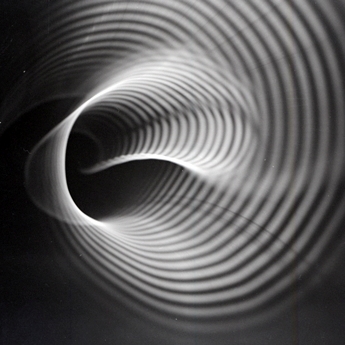
Franke is one of the earlier pioneers of this field. He experimented with light in a photo studio in the early 1950s and began making images with a small analog computer built specially for him by his colleague, the physicist Franz Raimann in 1954. The output device was an oscilloscope. This was two decades before computer art existed as a term. His significance is not only historical priority. He was among the first to think rigorously about whether a machine can produce beautiful visuals, and he answered yes, with evidence. He argued that mathematics is the hidden structure of visual beauty: the same frequency ratios that make a chord sound harmonious make a Lissajous figure look balanced. This was not mysticism, but empirical observation grounded in physics.
Can you define in few words what strikes you most about his works?
What impresses me most across all of these project series is the economy of means. A wire, a motor, a camera; an oscilloscope, a hand, some film. From almost nothing, Franke produced images of extraordinary complexity and beauty, largely by trusting what his materials wanted to do.
How about you? How did you get involed into computational art? Take us through your artistic journey.
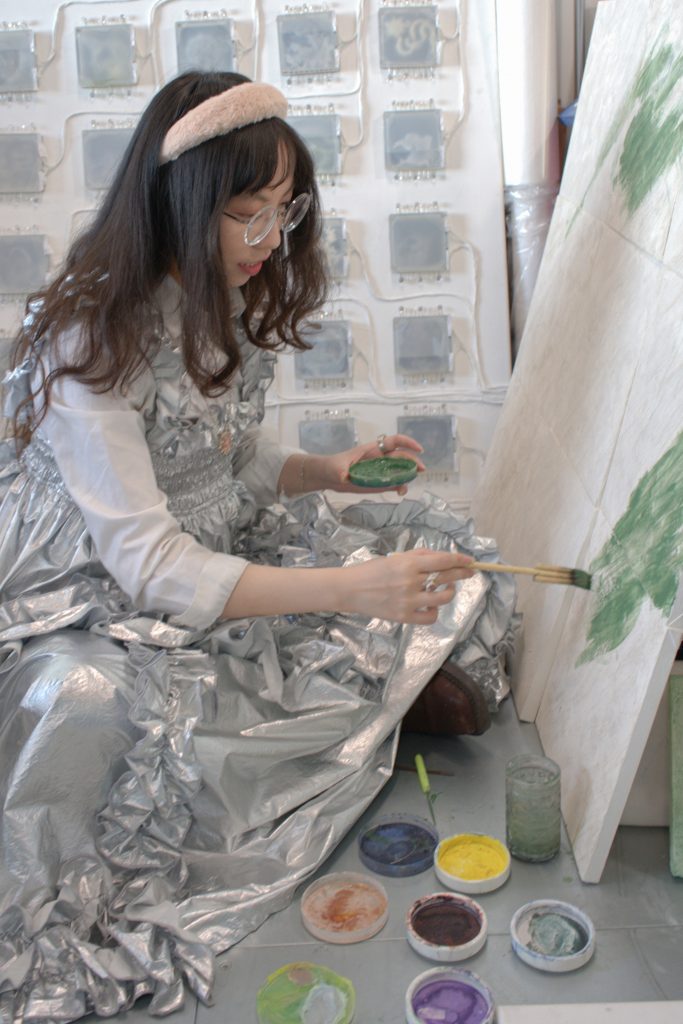
The most consistent thing about my practice, across every medium I have worked in, is that I prefer to work with materials rather than over them. Even in my earliest painting years, I was drawn to fluid, strongly textured materials, the kind that behave according to their own nature and cannot be fully directed. I have never enjoyed ways of working where every line and every surface is under the artist’s strict control. I would rather let the material itself become part of the language, respect its properties and its potential, and meet it halfway. What I have always been looking for is something that answers back, not a tool that obeys. I am well-trained in traditional fine art painting. I have studied Visual Communication at the Central Academy of Fine Arts in Beijing, then came to Goldsmiths for my MFA in Computational Arts.
When I began working with code, AI and electronics there, I recognised the same situation immediately. A generative model, like a fluid pigment, has its own tendencies, its own randomness, its own refusals. It answers back. My methodology, which I call Techno-Craft, is built on treating technology as an independent collaborator rather than a passive instrument.
That sounds really interesting! Can you give a bit more information about your approach?
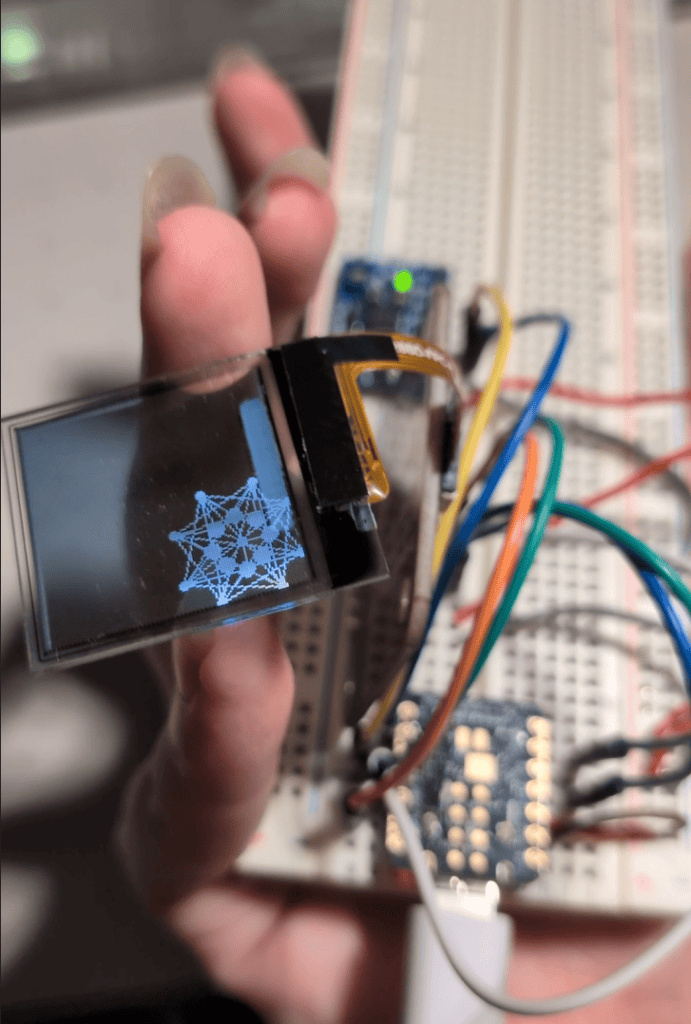
This approach runs through both my personal art practice and my teaching. In my own work, I explore how the granularity of the physical world can be preserved within the smoothness of the digital realm, a question that keeps me returning to the texture, randomness, and resistance of real materials even as I work in computational media. The same principle guides how I teach. I currently teach digital media at London College of Fashion and continue to work at Goldsmiths, alongside a studio practice at Kindred Studios in North Kensington.
In the classroom I try to respect each student’s autonomy rather than steer them toward the outcome I might have imagined. Often, we end up learning something new together. Through this process, I keep refining my perception with new ideas and experimentations, and these explorations feed back keep myself open and free in my art practices.
What exactly is computational art to you? Since art is traditionally seen as a human product, how do you view the dynamic between artists and computers today?
I think there is this anxiety that comes from thinking about the computer as a replacement for the artist. In my daily experience the relationship is nothing like that. It is much closer to a collaboration between independent parties, one of whom has remarkable capabilities and equally remarkable blindnesses.
Can you give a concrete example for this?
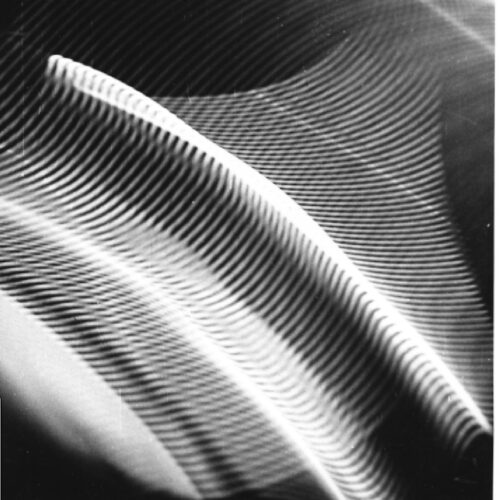
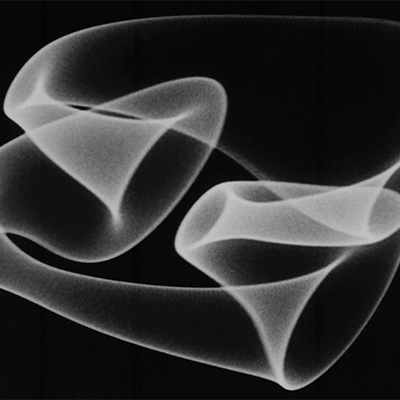
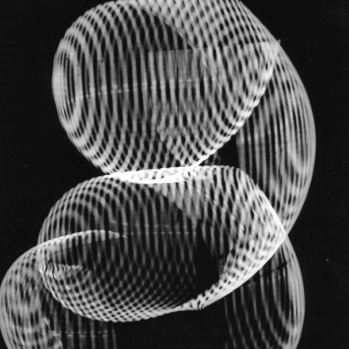
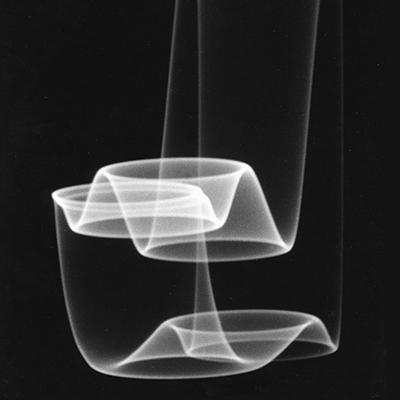
A concrete example from this project is, when I train an AI model on Franke’s photographs and ask it to generate new assets, the model frequently decides that these light traces are solid objects. The AI algorithm sees a white form on a black background and concludes this is a vase, and a vase in a video should rotate. So it rotates them. It has no way of knowing that what it is looking at is the trace of a vibrating signal, a record of motion rather than an object. I spent weeks observing this behaviour systematically, testing which parameters produce it and which suppress it. That misunderstanding, and the process of negotiating with it, taught me a lot about the nature of images.
But doesn’t AI diminish control over the artwork?
I should say that I have never wanted total control over my medium, and I think this is precisely what makes working with generative systems productive rather than frustrating. I set the conditions, the machine produces something, and I only aggregate and curate the results through selection. Franke worked in exactly this way in the 1950s with his oscilloscope: he adjusted the dials, the screen presented him with something, and he decided whether it deserved to be photographed. The instruments have changed beyond recognition. The structure of the collaboration has barely changed at all. His significance is not only historical priority. He was among the first to think rigorously about whether a machine can produce beautiful visuals, and he answered yes, with evidence. He argued that mathematics is the hidden structure of visual beauty: the same frequency ratios that make a chord sound harmonious make a Lissajous figure look balanced. This was not mysticism but empirical observation grounded in physics
You mean something like art as science?
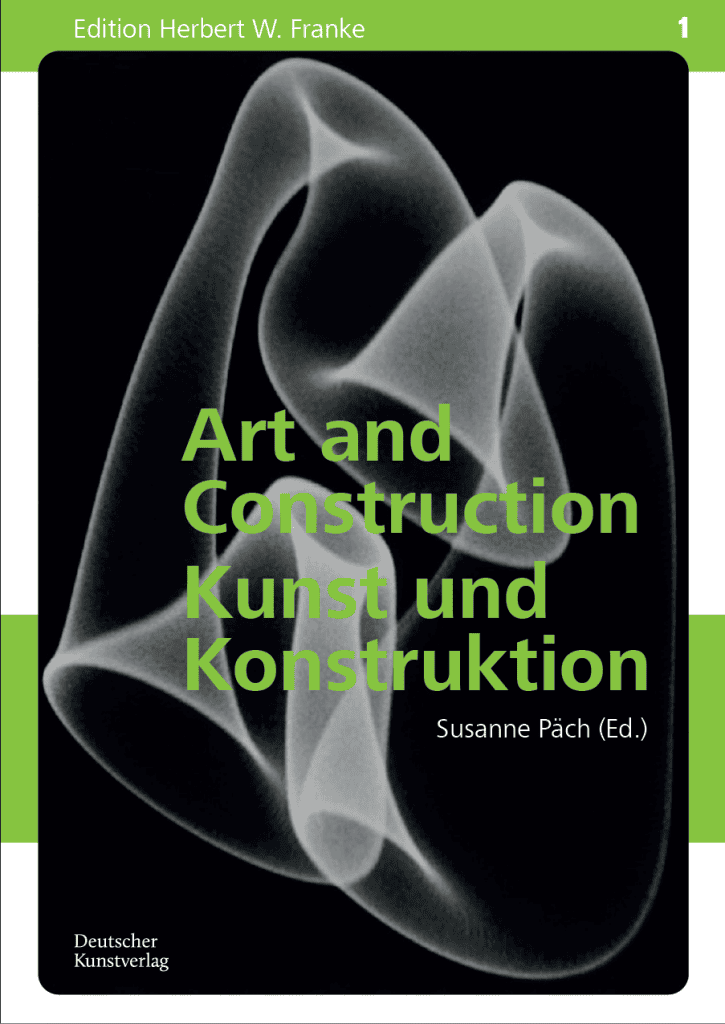
Yes, absolutely right. For Franke, the human’s task was to create art based on analytically defined mathematical principles, while keeping the machine and its capabilities in mind. In his groundbreaking 1957 book Art and Construction, he envisioned a future where humans and man-made technology work in collaboration—whether through specific hardware or later software—while respecting the unique abilities of the machine counterpart.
What strikes you most in Franke’s work?
It is his attitude toward his instruments. Franke did not force the oscilloscope to illustrate a preconceived image. He respected the physics of the system, its randomness and its mathematical character, and allowed the medium to speak in its own language while he listened and selected. This is precisely the relationship I try to maintain with machine learning systems, and I believe it is the deepest continuity between his generation and mine. Every artist working with generative AI today follows a similar methodology, whether they know his name or not: establish a generative system, let it produce, then choose. I think more of them should know his name.
What kind of impression has his work made on you?
The impression has been layered. At first, it was simply aesthetic: the images are beautiful in a way that needs no explanation. But as I studied how they were made, admiration turned into something closer to recognition. Franke worked the way I have always wanted to work: he set up conditions, respected the autonomy of his instruments, and treated the unpredictability of the medium as a source rather than an obstacle. Encountering that attitude in someone working seventy years ago, with completely different tools, was quietly moving. It made the project feel less like studying a historical figure and more like continuing a conversation.
Now, let’s talk about the project itself. What exactly does the task involve?
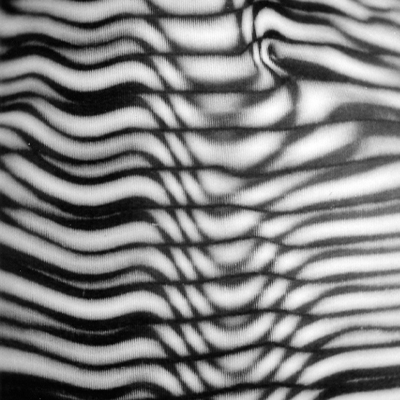
I am working with early photographic series from the 1950s, each produced through a different analog process. We are using this dataset to train an AI model that translates Franke’s early 1950s works—created using photo cameras, light experiments, and an early analog computer—into an immersive environment of moving images. This is a visionary concept Franke himself anticipated back then, though the technology to realize it did not yet exist process.
Describe some of the pieces that most impress you — and why?
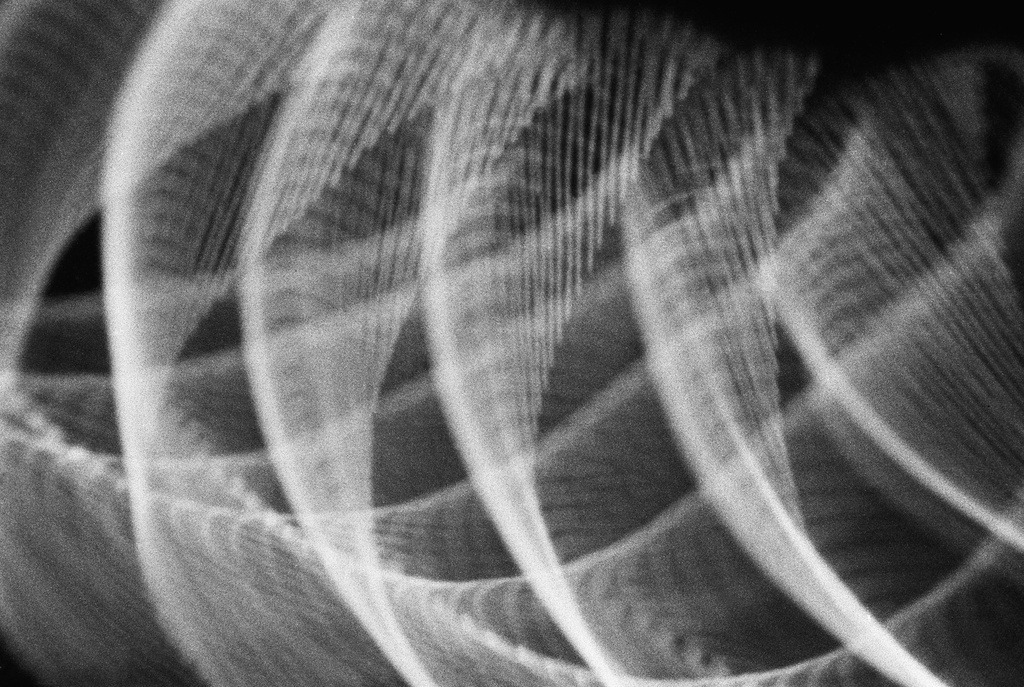
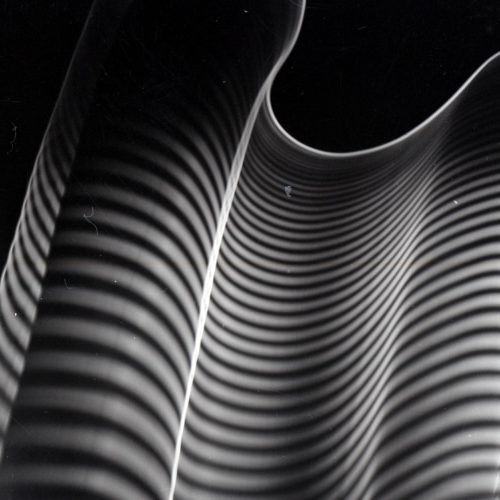
The series I love most is the Analogrechner-Oszillogramme of 1954 to 1958, in particular the group Franke titled Fächer and Schleier, fans and veils. To me these images feel almost weightless, like feathers: fine luminous filaments gathered into sweeping, layered forms. What holds me is their rhythm of density, the way tightly woven passages open into sparseness and then gather again, so that the eye keeps moving between fullness and air. It is a compositional rhythm my training in East Asian painting taught me to look for, and Franke achieves it with an analogue computer. The level of detail is extraordinary as well; you can follow a single strand of light through the entire figure. And the lightness is deceptive, because behind it sits real machinery. Franke generated the signals with the analogue computer built by his colleague Franz Raimann by Franke’s concept, displayed them on an oscilloscope screen only five centimetres wide, and moved the camera during the exposure, so that the small figure fanned out across the film into those fans and veils. The mathematics is exact, but the hand holding the camera is human, and both are visible in the final image. That a process this precise can produce something this delicate is, for me, the heart of his work.
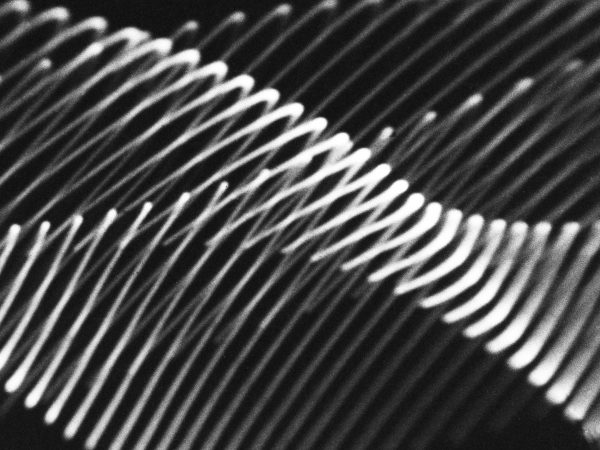
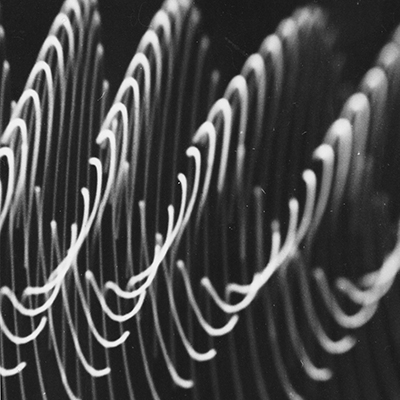
Then there is also Tanz der Elektronen (Dance of the Electrons). It strikes me in a completely different register. These images are pure energy: swarms of luminous points and streaks caught in motion, as if the photograph had captured particles mid-flight. The image does not depict movement, it is movement, deposited directly onto film. That kinetic charge is a quality I hope to carry forward when I set these forms into motion with AI.
How will you go about — both practically and artistically — re-rendering it (if that is the right word)?
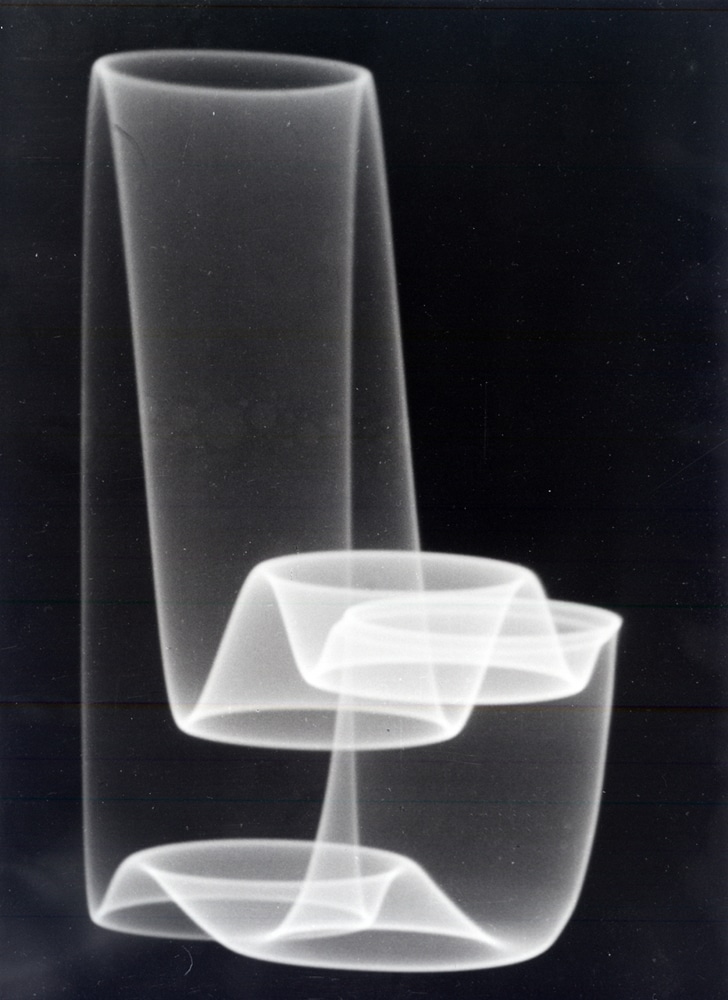
I am glad the question includes “if that is the right word,” because I would not choose “re-rendering.” The word render subtly implies taking something already defined and outputting it again. To put that into context, it would feel like treating Franke’s photographs as surfaces to be reproduced. But the more I learn about them, the more certain I am that the surface is the least important part. These images are records of processes: signals, rotations, exposures unfolding in time. What I am doing is better described as re-imagining: taking the processes behind the images seriously and asking what they can become with the systems of our own time.
But what means “re-imagining” practically?
Practically, this means training custom AI models on his original photographs and generating slow video works in which his forms continue to move, as well as the decomposition and reconstruction of elements from his original methods, down to the instruments and signals he used. We try to re-imaging his future vision of generated moving images written in Art and Construction 1957. Artistically, it means holding myself to the same relationship with my medium that he held with his: establish the conditions, let the system produce, and accept that the most interesting results are the ones I could not have planned. If there is a fidelity I am aiming for, it is fidelity to his method rather than to his surfaces.
What are the concrete project steps, processes, and methods you will deploy?
The process consists of several concrete stages. The first is research. I work closely with Susanne Päch, Franke’s wife and a central figure in the stewardship of his legacy, and we meet weekly. Through her, I am learning not only what the images look like, but exactly how they were made: which instruments, signal sources, cameras, and exposures were used. This dimension of the project has grown steadily more important to me. To support this, Susanne has given me access to around 2,000 high-resolution digitized photographs of Herbert W. Franke’s early generative art. The second stage is training. Using these images, I am training a LoRA—a lightweight adaptation model—on top of Stable Diffusion XL. This allows the model to learn the specific character of Franke’s light traces, the grain of his film, and the way his curves intersect and overlap. This allows the model to learn the specific character of Franke’s light traces, the grain of his film, and the way his curves intersect and overlap. While the vast majority of his historical generative works from the 1950s are in black and white, I am also experimenting with his rare color series from that same era, using double-exposed post-production techniques.
You mentioned an archive of 2,000 images. This is a huge number!
You are right. This is where a large part of my authorship comes in. It is the third part, which involves selecting and sequencing the huge amount of material. The model produces far more images than I could ever use. From thousands of outputs, I select a small number into a working folder, and then I sequence them, which is essentially storyboarding. I generate video with a technique called First-Last-Frame-to-Video: I give the model two images, and it generates a few seconds of motion between them, each clip only three to five seconds long. This means the overall direction of movement across the whole work is largely decided by me, through which images I pair and in what order I place them. Sequencing still images for future motion is demanding in a particular way: I have to imagine, in my mind, how each static form would move into the next, and find an order that feels right before any movement exists. It calls on aesthetic judgement and imagination as intensely as any painting decision. Once the sequence is set, I name the files 001, 002, 003, and batch-load them in ComfyUI, so that the final frame of each clip becomes the first frame of the next, and the model generates one continuously connected video.
And the fourth stage?
The fourth stage is the generation itself, and here I deliberately let go. Arriving at the right kind of motion required a long period of systematic experiment. Video models are trained to produce drama: fast movement, rotation, transformation. Franke’s aesthetic requires near-stillness. I ran controlled tests, changing one variable at a time, a model weight, a sampling schedule, a prompt structure, until I understood which controls actually govern motion and which govern detail. I would say this experimental process is not preparation for the work; it is the work.
How will this work be presented finally?
It will be a video performacne. For this, we have the fifth stage: the editing of the material. The generated footage is still raw material. I cut, pace, and structure the final piece manually, deciding its overall rhythm and duration. The machine produces passages; the composition of the whole remains a human task.
How would you describe your and your AI’s part in this fascinating project?
So to the question of how much is my action and how much is computational mediation, the honest answer is that control moves in a rhythm. Before the model, my control is high: the training data, the selection, the storyboard. Inside the model, I deliberately release control, and the model contributes its own interpretation, sometimes wrong in a beautiful way, sometimes simply wrong. I push against its misreadings while respecting its nature, the way a painter respects a fluid medium while still directing the painting. After the model, control returns to me in the edit. The work is made in this alternation of holding and letting go, and I have come to think the alternation itself is the method.
If I were to observe you in your studio working with the Franke pieces, what would I see?
Mostly you would see me staring at screens, which I realise is not very romantic. But the decision-making behind the staring is intense. On one monitor there is ComfyUI, a node-based interface for AI, and video generation. It resembles a circuit diagram: dozens of interconnected nodes, each controlling one part of the process. I spend hours adjusting single numbers, the weight of a model, the noise schedule, the number of sampling steps. One small number can change the entire character of the output. The comparison is not decorative: it is genuinely similar to turning the frequency dial on an oscilloscope, where a small adjustment produces a fundamentally different figure. On another screen, the outputs. I generate in batches, sometimes a hundred videos overnight, and in the morning I review them. Some are rejected. I am looking for the rare moments when the model produces something that feels true to Franke’s sensibility without merely copying it, and the selection is where the artistic judgement lives.
You are talking about the screens only. But what about the room you are in? Does it still exist for you, or are you ‘living’ inside the screen?
Of course it exists—it is my real life! On the wall, my own paintings. My studio remains a painting studio as much as a computational one: small canvases with heavy texture, mineral and metallic surfaces, a large green piece scattered with gold leaf, works finished and unfinished. Their presence is not incidental to the Franke project. After hours inside the smoothness of the digital, I need to be surrounded by surfaces with grain, weight, and resistance. They remind me what images are before they become pixels, which is, in a way, the question this whole project keeps asking.
Is there anything you personally learned from this project?
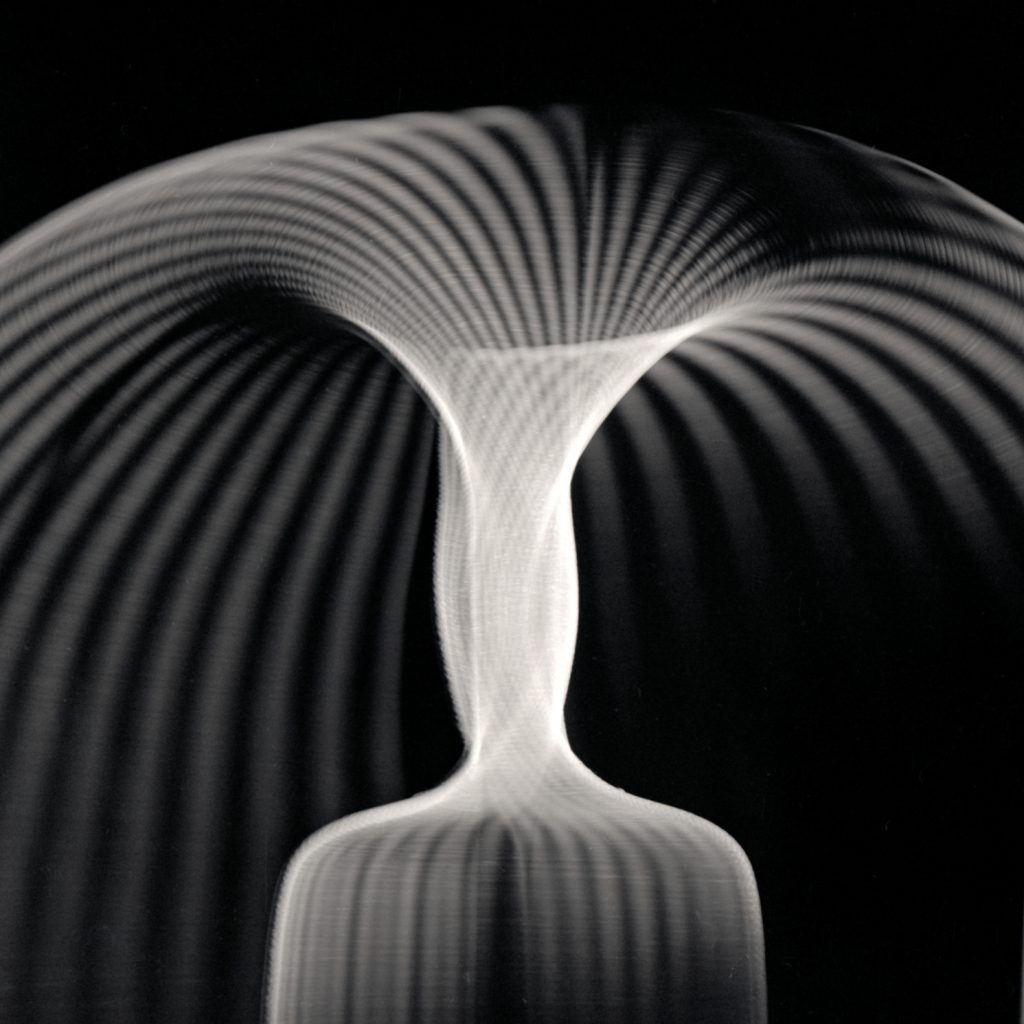
That realization pushed me to study his actual methods—the oscilloscope, the signal sources, the cameras — and it changed my understanding of what these images are. A Raumstudien photograph is not a picture of a “vase”. It is its underlying foundation—a record of a creative aesthetic process visualized through mathematics: a wire turning in darkness for several seconds. But it goes even further: for Franke, this underlaying mathematics is not only the principle of his own artistic creations, but a model of aesthetic processes itself. In this light, a real vase is merely one of its physical manifestations, just as Franke’s Raumstudien serve as its virtual representations. This shift, from seeing artworks as a mere final result to seeing them as records of processes, may be the most important thing this research has to teach, and it applies equally to AI-generated images. When we look at an AI-generated image, we tend to see a finalized picture. But it, too, is a record of a process: a particular model, trained on particular data, sampled with particular parameters. If we only look at the surface, we place ourselves in the same position as the machine. Franke understood this seventy years ago. I came to understand it through this project.