




Cooperation With THe Technisches Museum Wien
Project for Restoring of Franke’s Programs with Cellular Automata
The Foundation Herbert W. Franke has entered into a cooperation agreement with the Vienna Museum of Science and Technology and the Austrian Mediathek. The goal is to work alongside the Software Archive & Collection—based at the museum’s research institute—to preserve a portion of Franke’s digital computer programs for the long term and to make them accessible to the public both online and offline in the exhibition.
Technisches Museum Wien
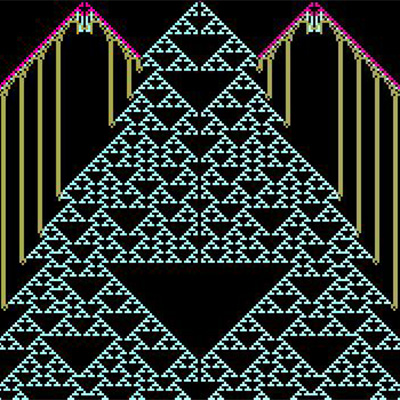
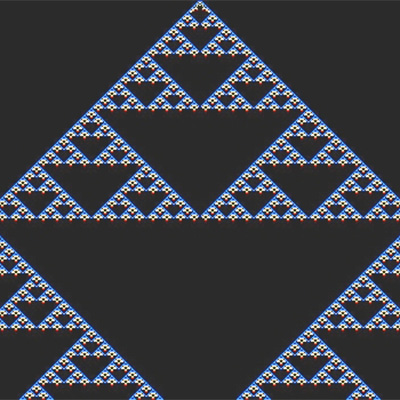
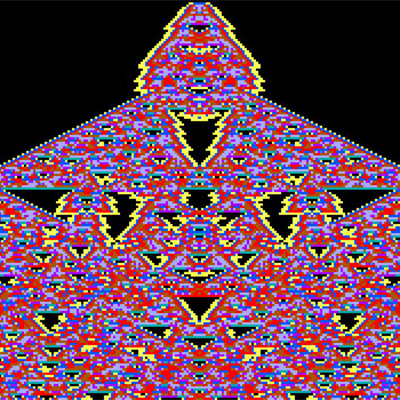
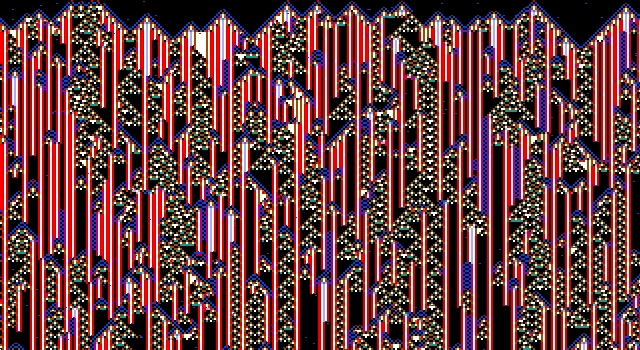
The project kicks off with the cellular automata software package, which we will make publicly available to mark the 100th anniversary of Herbert W. Franke’s birth. Positioned at the intersection of art and science, these experiments are directly linked to his 1995 book Das P-Prinzip (The P-Principle). It stands as one of his most significant publications, reflecting his comprehensive, natural-philosophical understanding of the world. The work is scheduled to be published in English translation for the first time in 2027 as part of the Edition Herbert W. Franke.
Franke, who held a PhD in theoretical physics, was convinced that the world is nothing other than pure mathematics—specifically, the algorithmically defined interplay between an order structured by laws and truly random processes within the quantum realm. He considered these processes to be the evolutionary engine of innovation in a non-deterministic world. In this respect, the code underlying the laws of nature, which regulates the interplay of both worlds on the path toward higher complexity, was for Franke the key to understanding cosmic evolution all the way to human intelligence. For Franke, it is this overarching code that connects the initial conditions and the laws governing the universe with quantum-physical, non-deterministic—and thus “true”—random processes into a comprehensive total system. From his perspective, the future was therefore not predetermined. His visual experiments demonstrate how a universe without random processes leads to stagnation, meaning thermal death, whereas true random processes may enable a universe that might even evolve infinitely. This is also where the question comes into play whether dark energy is an immutable law of nature or if it potentially weakens over the course of cosmic history. To this day, this question remains scientifically open. A more detailed introduction to the P-Principle here.
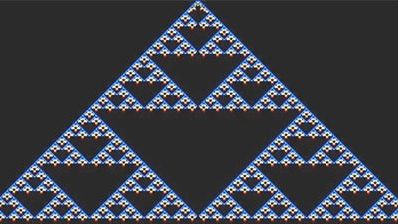
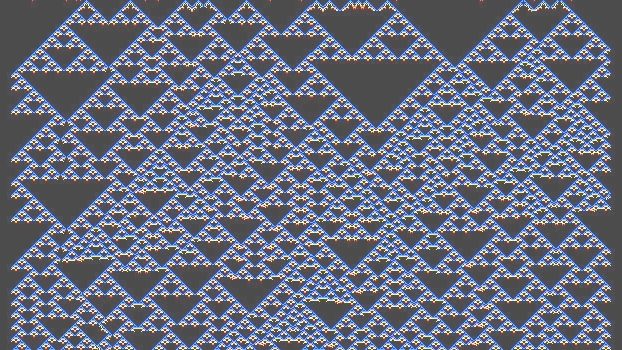
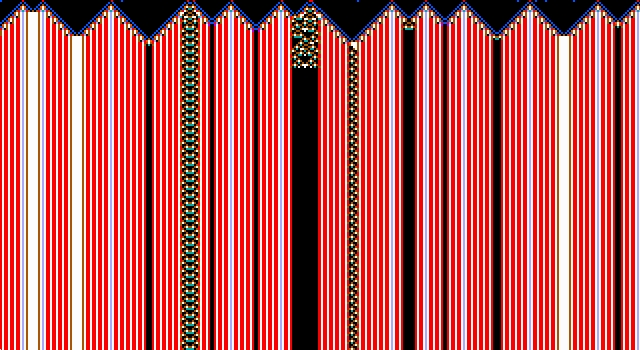
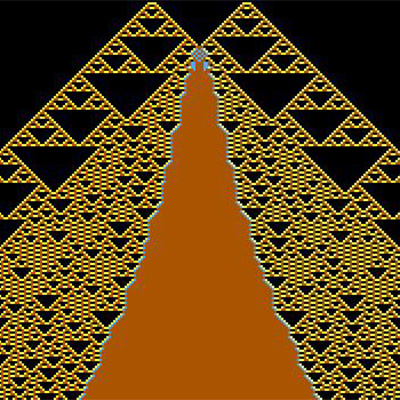
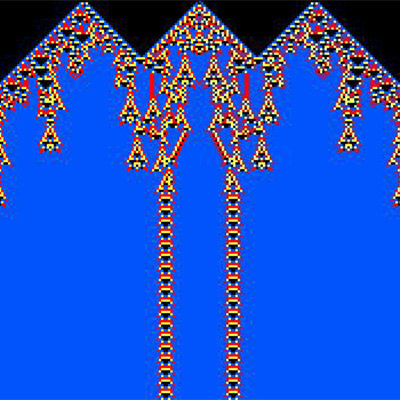
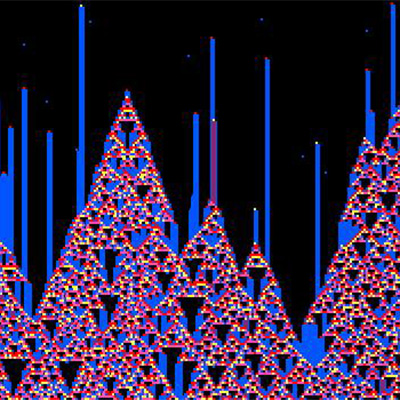
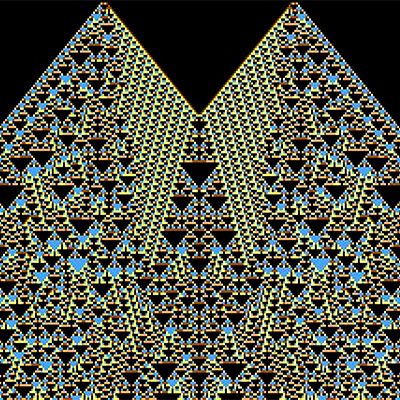
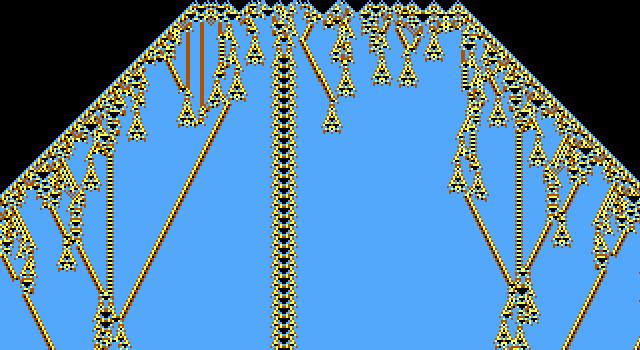
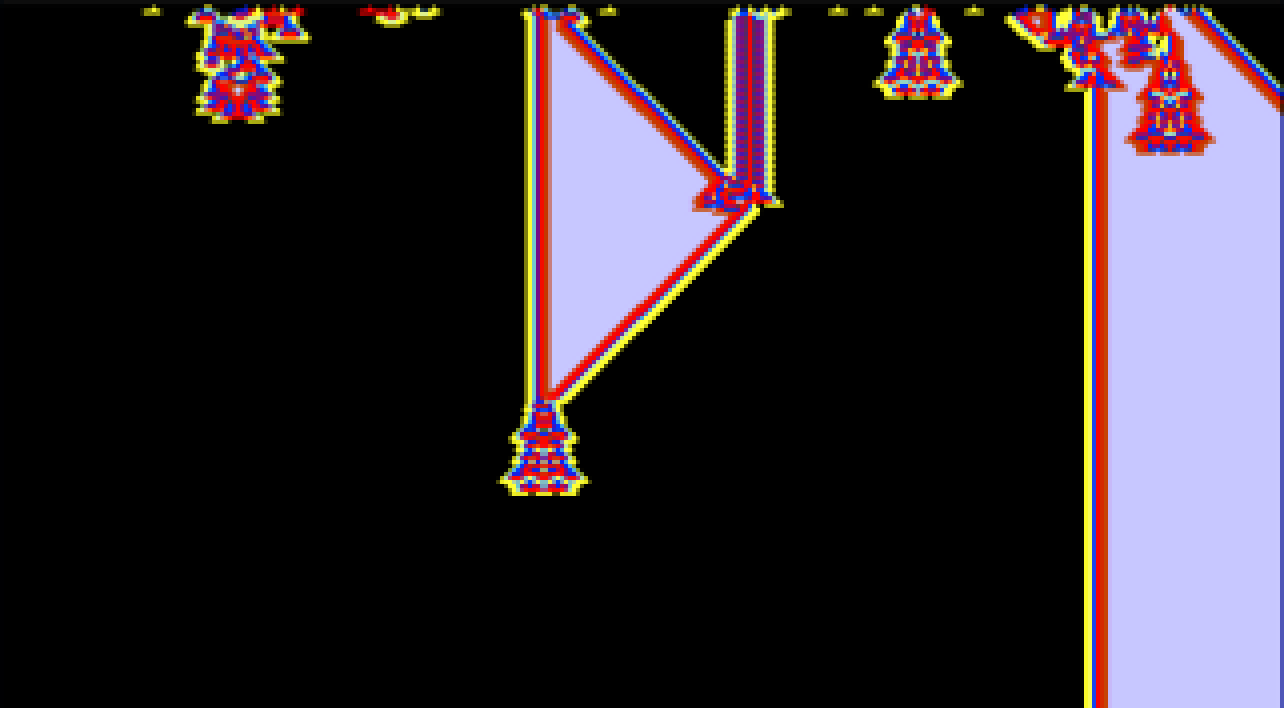
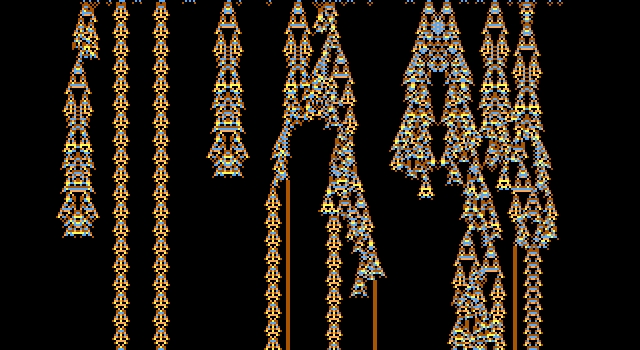
To investigate this understanding of the world, the scientist Franke used cellular automata as a simple, creative testing ground for varying physical processes in evolutionary models, whose natural laws he sought to playfully transcend. In doing so, the artist Franke always took the purely aesthetic aspect into account as well—for instance, through his choice of colors. Today, cellular automata are a widely used coding medium in generative art. Susanne Paech is therefore delighted that the Vienna Museum of Science and Technology through its Software Archive & Collection, aims to make the cellular automata programs publicly accessible again in this collaborative project—serving as an early historical example of this creative application. “I would like to thank the Vienna Museum of Science and Technology, its Director General Peter Aufreiter, and the entire team at the research institute for their interest and active cooperation in making these programs accessible.”
Herbert W. Franke’s P-Principle: Scientific Background

In modern natural science, the interplay between natural laws and chaos is considered a fundamental principle of pattern formation, evolution, and the preservation of life. The most important link is the concept of deterministic chaos, which serves as the foundation for the self-organization of matter. This can be calculated using models like the Lorenz attractor. In contrast, non-deterministic chaos, as it exists in the quantum world, loses hidden mathematical structure. For Franke, this was the starting point for his thought experiments on the P-Principle. He systematically took the interaction between the natural laws of the macro- and micro-world and the genuine random processes of the underlying quantum world to a higher level: as a control structure information-theoretically superimposed on both the laws and the true chaos. This overarching moderation of the P-principle ensures that the evolution of the cosmos receives a clear direction: increasing complexity. The universal program allows chaos to occur at the specific points where innovation, evolution, and biological diversity are meant to emerge (e.g., in mutations). In this way, the development of the cosmos receives a teleological principle that inevitably leads to consciousness and intelligent structures within this calculating space.
The program allows chaos to occur at the specific points where innovation, evolution, and biological diversity are meant to emerge (e.g., in mutations). At the same time, it confines this chaos through the natural laws of the macro-world so that the overall system does not “collapse” into total chaos. In this way, the development of the cosmos receives a teleological principle that almost inevitably leads to consciousness and intelligent structures within this calculating space.