




Does God Exist – and do We Live in a Calculated Universe?
In 2026, the art meets science – Herbert W. Franke Foundation produced a sci-fi cycle featuring three short stories by Franke, specially designed for fulldome and immersive theater. These works will be showcased multiple times during the anniversary year as part of the event series HERBERT W. FRANKE 100. The utopian works of physicist Herbert W. Franke—long considered sci-fi classics—revolve around humanity’s greatest questions: Does the universe have a purpose? And is there a creator? How might we imagine them?
Science fiction trilogy featuring multimedia readings of three short stories
A Leap into the Void shows the intense inner confict between human faith and knowledge. A prophet encourages a group of people to jump into a mist-shrouded abyss, proclaiming: “You can fly! You just have to believe!” Yet the protagonist Frederik refuses to jump, even as the last man standing—until the secret of his existence is revealed in a dramatic plot twist. In The Green Comet, the title story of the anthology of the same name, the author introduces the creator of worlds as a multidimensional, abstract principle. Finally, in The Evolution Game, Franke portrays a divine being, a world programmer, who could best be described as a kind of computer gamer.
The P-Principle: Scientific Background
Behind these three stories are Franke’s thoughts on the P-Principle, which he published in a natural philosophical book of the same title with Insel in 1995. It will be published in 2027 as the third volume of the bilingual Edition Herbert W. Franke, for the first time also in English.
In modern natural science, the interaction of natural laws and chaos is considered a fundamental principle of pattern formation, evolution, and the preservation of life: the concept of deterministic chaos, upon which the self-organization of matter is based. With the research of Edward Lorenz, the hidden structures existing within this deterministic chaos can be mathematically calculated (Lorenz attractor). However, this is contrasted by the real, non-computable chaos of pure noise that enters the world through quantum processes. For Franke, this was the starting point for his thought experiments on the P-Principle. He consistently took the interplay of the natural laws of the macro- and microworld and the real random processes of the underlying quantum world to a higher level: as a regulatory structure superimposed on the laws and real chaos in terms of information theory. This overarching moderation by the P-Principle ensures that the evolution of the cosmos receives a clear direction: increasing complexity. The universal program permits chaos at the specific points where innovation, evolution, and biological diversity are meant to arise (e.g., in the case of mutations). In this way, the development of the cosmos receives a teleological principle that inevitably leads to consciousness and intelligent structures within this calculating space. See also teh Foundation’s project in cooperation with the Science Museum Vienna.
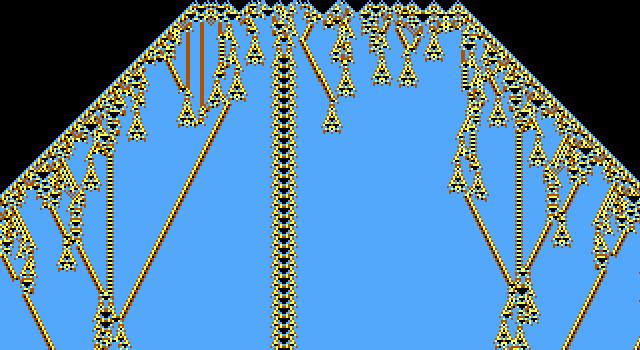
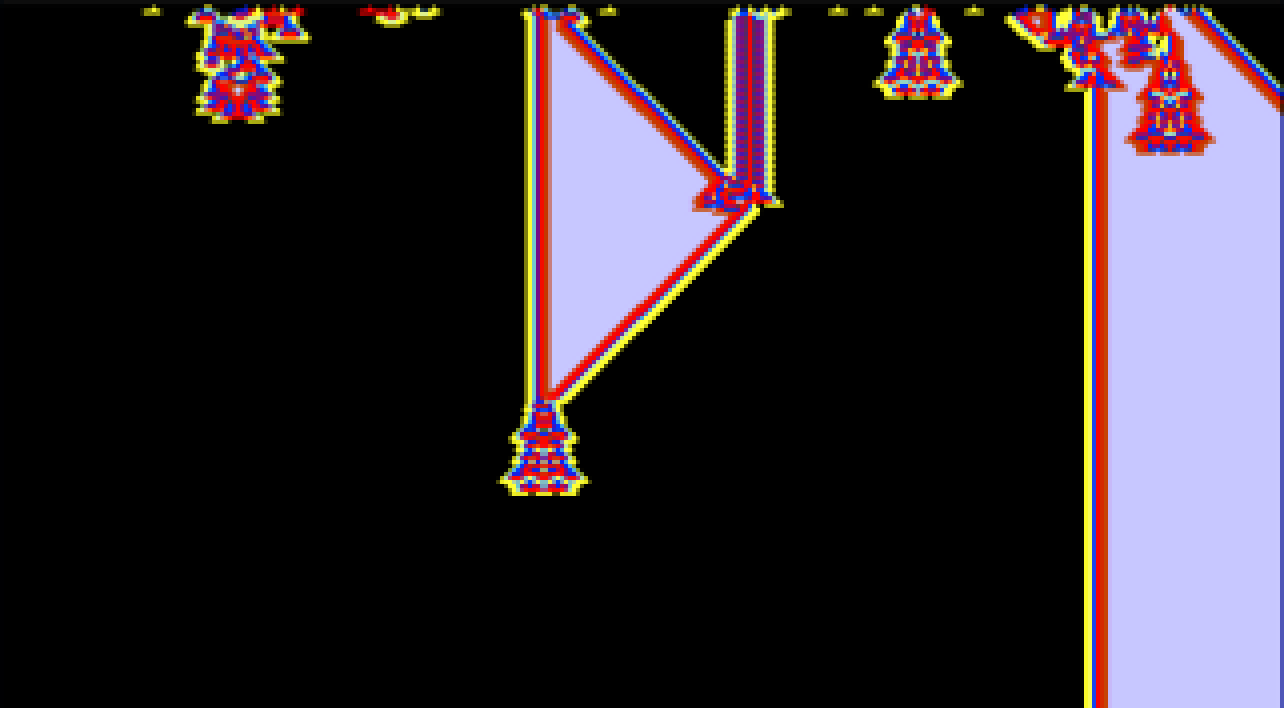
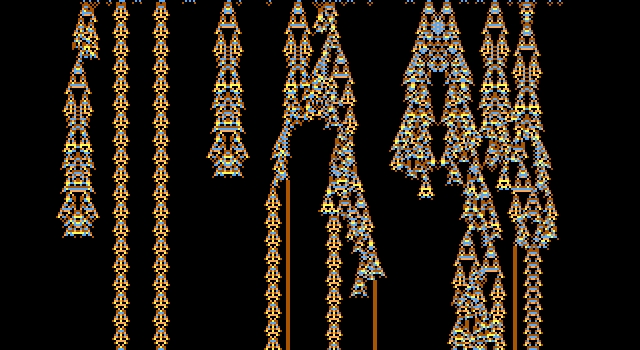
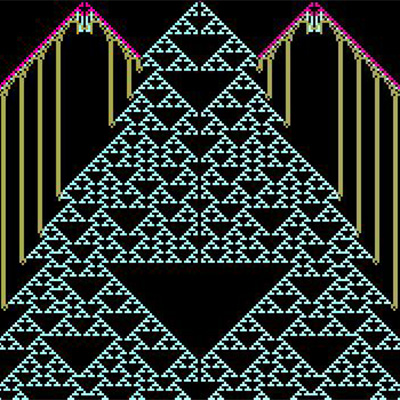
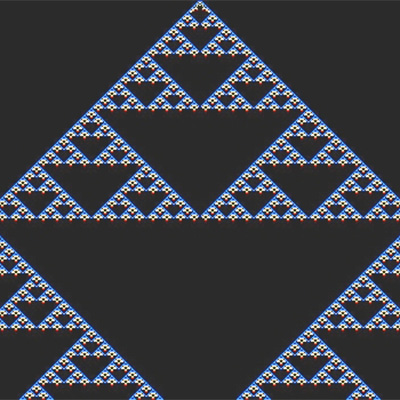
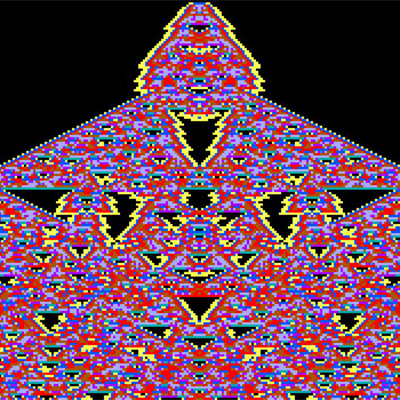
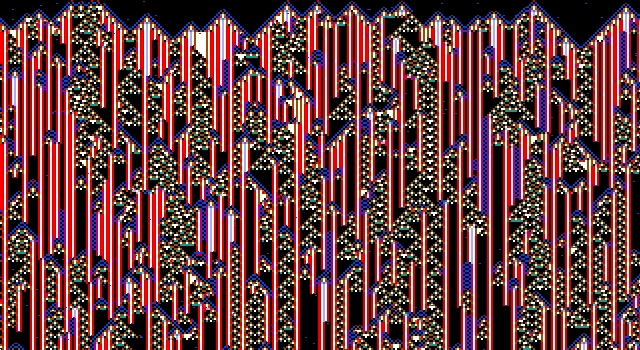
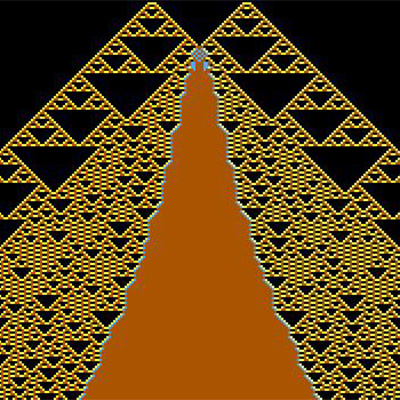
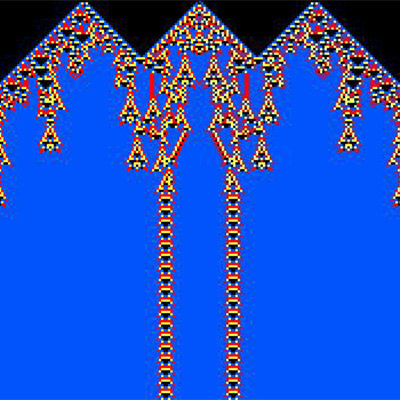
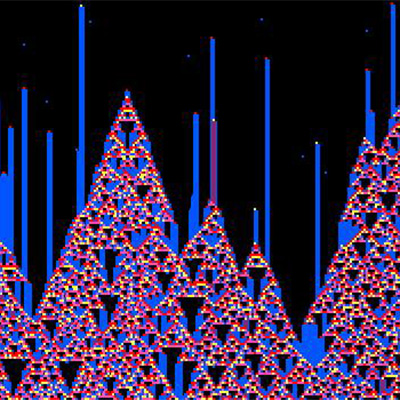
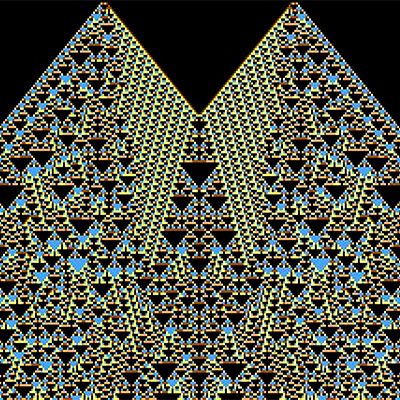
With one-dimensional cellular automata, Franke not only experimented with different world models, but as an artist, he also sought to transform these into striking visual structures through his choice of colors. However, as a theoretical physicist, Franke did not concern himself with the question of whether this teleological world requires a creator. For him, science ended where hypotheses could no longer be empirically verified or theoretically modeled—precisely where the metaphysics of the mathematically infinite begins. Instead, he considered this terrain a playground where the artist can leave the boundaries of verifiable facts behind and creatively “play through” various models. In Franke’s work, this is also evident in utopian stories such as The Evolution Game …