




Axel B.C. KRauss
Is there a choreography of the dancing spirit on the stage of matter?
The philosopher Friedrich Nietzsche once wrote: “If our senses were sensitive enough, we would experience the motionless rocks as dancing chaos.” It is more likely the opposite: We would then experience them as dancing order, which, however, allows for “chaos”—that is, random factors—within certain limits in order to bring forth something new: creative variations and innovations. More precisely: new levels in the “hierarchy” of the world’s structure—from very simple, perhaps even the simplest initial conditions or basic pre-requisites, to ordered structures of increasing complexity. From the subatomic—from the quantum world—to atoms, molecules, molecular aggregates, and on to organic life forms, single-celled organisms, plants, animals, and humans—who, by virtue of their consciousness and thought, are capable of asking questions about what, as Goethe’s Faust asked, holds the world together at its core.
The Austrian physicist, non-fiction author, and science fiction writer Herbert W. Franke (1927–2022) explores such questions in the present book, The P-Principle, first published in 1995 by Insel-Verlag, whose subtitle is not without reason: Natural Laws in Computing Space [1]. For it is possibly this “computing space” that provides the choreography. Franke borrows this concept from the German computer engineer Konrad Zuse, who—which is of course not to be understood literally, but rather as an analogy, as a mnemonic device—developed the idea that this choreography might resemble a computer program, whose laws of nature give structure to the dancing chaos and ensure that there is any consistent development at all.
[i] Zuse, Konrad: Rechnender Raum, Schriften zur Datenverarbeitung, vol. 1, Vieweg, Braunschweig 1969.
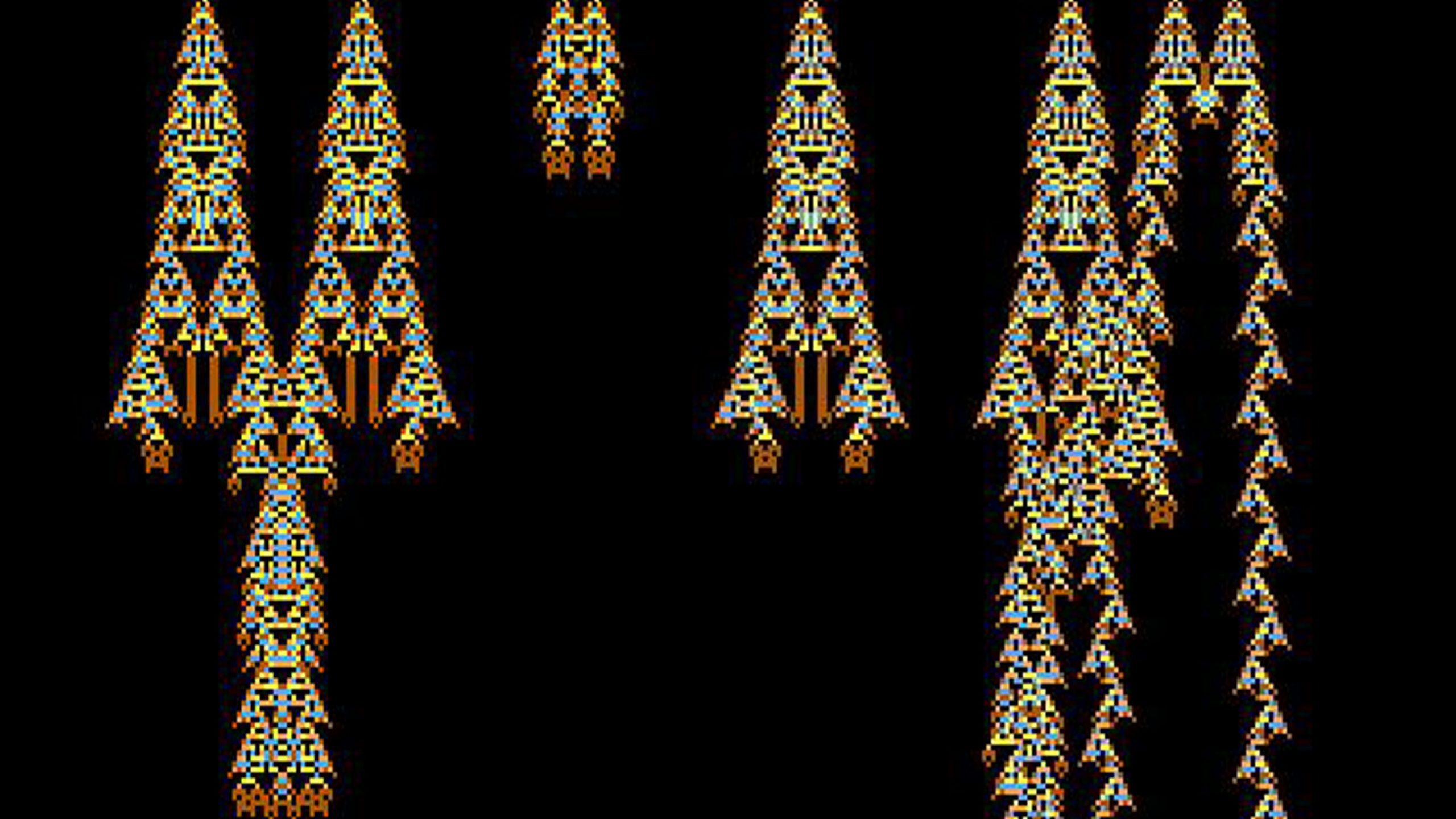
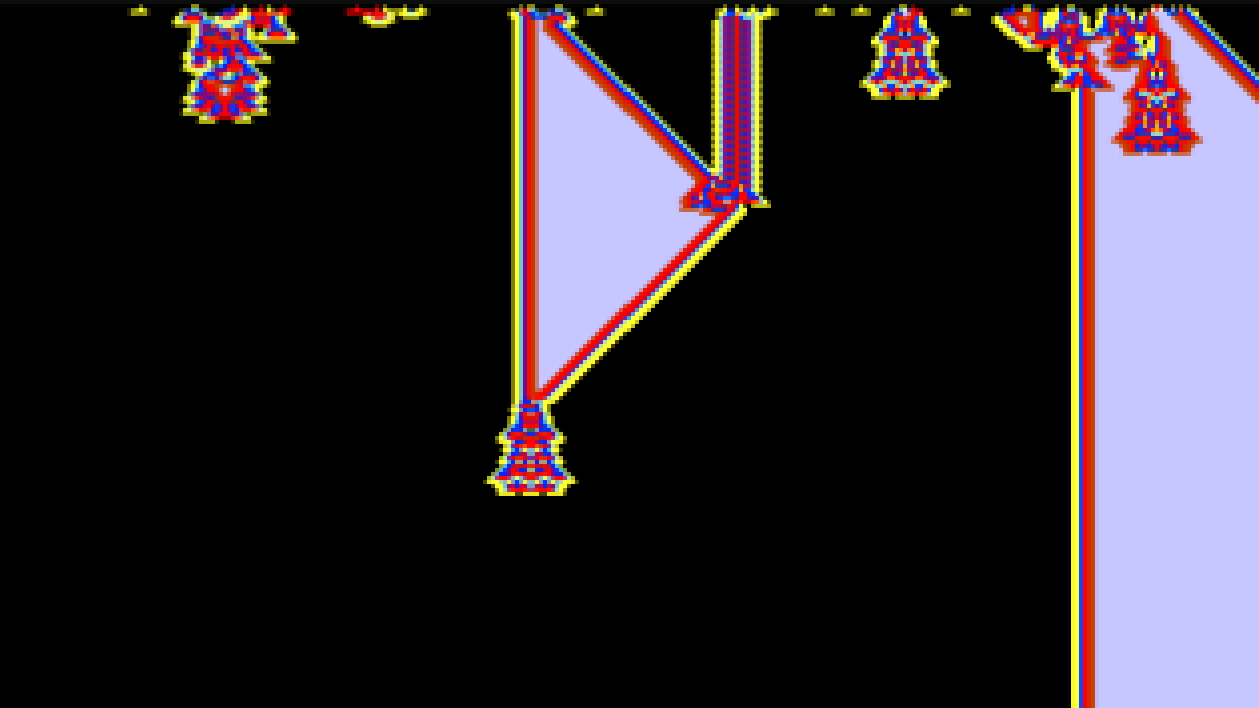
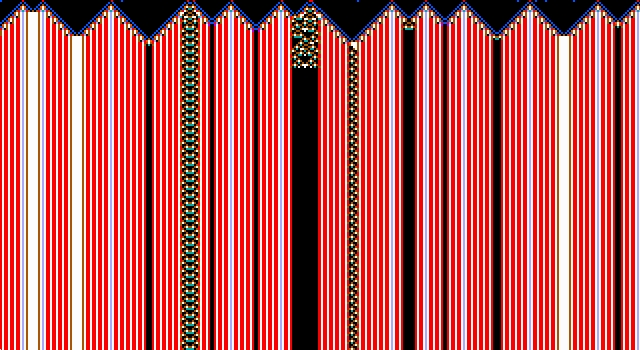
Franke’s modified thought experiment on the universal P-principle, grounded in Zuse’s concept of Calculating Space (Rechnender Raum), can be concisely summarized as follows: In contemporary natural science, the interplay between physical laws and deterministic chaos is recognized as a foundational principle of morphogenesis, evolution, and homeostatic life preservation. Through the research of Edward Lorenz, the latent structures inherent in deterministic chaos can be mathematically modeled—exemplified by the Lorenz attractor. This stands in stark contrast, however, to the genuine, non-computable chaos of pure noise introduced into the phenomenal world via quantum processes. Franke systematically extended this interplay of macro- and micro-physical laws with the ontological randomness of the quantum realm onto a higher conceptual plane: a cybernetic control structure information-theoretically superimposed upon both deterministic laws and stochastic chaos. This overarching equilibrium between structural formation and random processes, driven by an information-theoretic superstructure, imparts a distinct vector to cosmic evolution: increasing complexity. Franke defines this teleological principle, which prescribes a directional trajectory to cosmic development, as a systemic imperative: Evolve toward increasingly complex, higher-order life forms, culminating in sentient beings capable of interrogating their own existence and the foundational conditions that precipitated it [2].
The Calculating Space
There are many analogies from the world of computing that could be applied to Franke’s interpretation of the Computing Space: One could conceive of it as “existential hardware” on which the software of the laws of nature runs in a spatiotemporal-evolutionary manner and “projects” a material world onto the screen of our human experience. It could originate from the non-classical quantum space of probabilities, probability, and potential—nonlocality—to be realized in the locality of the computing space. Then space would be a kind of logical gate where it is decided which possibilities are realized or not.
Consequently, one may ask whether a sharp distinction between the two domains would be appropriate at all—that is, whether one could conceive of “hardware” and “software” as completely separate from one another. The American quantum physicist and philosopher David Bohm (1917–1992), for example, developed the theory of so-called holomovement—by which he meant that, analogous to Einstein’s attempt at a unified field theory, one must conceive of the universe as a holistic field, that is, apply a holistic perspective to it. In his book of the same name, published in 1980, Bohm spoke of an implicit order—in the sense of a “folded-in” order that could be compared to the encoded “software” of the computer analogy, which then “unfolds” spatiotemporally and evolutionarily. According to Bohm, the two cannot be strictly separated from one another [3].
What is interesting now are the possible points of connection between Bohm’s implicit order and the Computing Space, especially in connection with the model of cellular automata, as Franke discusses them in Das P-Prinzip [3]: The concept of a “folded” order, which in a certain sense implicitly contains the “whole” within itself, could indeed be well combined with the iterative principle, that is, fractal mathematics: a computational formula whose result is “fed back” into itself—this process is repeated either in a finite number of steps or even infinitely.
The Dutch physicist and Nobel laureate Gerard ‘t Hooft applied the model of cellular automata to the entire field of quantum physics in his 2016 book The Cellular Automaton Interpretation of Quantum Mechanics. There is a bewildering array of theories attempting to make sense of the glue that holds the world together: As Franke also correctly notes, these are and remain only fragmentary insights, merely brief glimpses through theoretical “keyholes.”
Heisenbergs Beobachter-Problem
Quantum physics, with its notorious observer problem, raises the question of how precisely reality can actually be observed or “mapped.” Regarding the insights of quantum physics, Werner Heisenberg wroteDie Quantenphysik mit ihrem berüchtigten Beobachter-Problem wirft die Frage auf, wie genau sich die Wirklichkeit tatsächlch beobachten, „abbilden“ lässt. Werner Heisenberg schrieb zu den Erkenntnissen:
When we speak of the picture of nature in the exact science of our age, we do not mean a picture of nature so much as a picture of our relationship with nature. […] Science no longer confronts nature as an objective observer but sees itself as an actor in this interplay between man and nature. The scientific method of analysing, explaining and classifying has become conscious of its limitations, which arise out of the fact that by its intervention science alters and refashions the object of investigation. In other words, methods and object can no longer be separated. [4]
Franke incorporates this extremely important aspect of the development of the natural sciences into his book. Likewise, the question automatically linked to it regarding the origin of the cosmos: How did the universe come into existence in the first place? Franke bases his approach on the Big Bang theory. And he correctly points out that it, too, is merely a theory—it may be the “best” one to date, or perhaps better said: one that has solidified into cosmological and astrophysical orthodoxy, but it, too, has certain explanatory shortcomings.
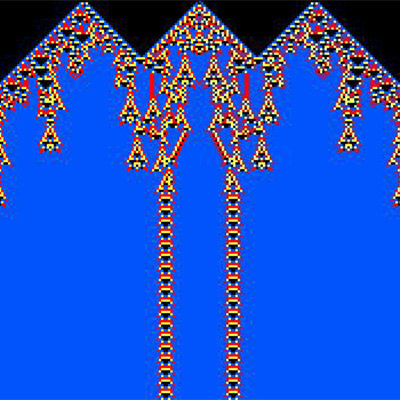
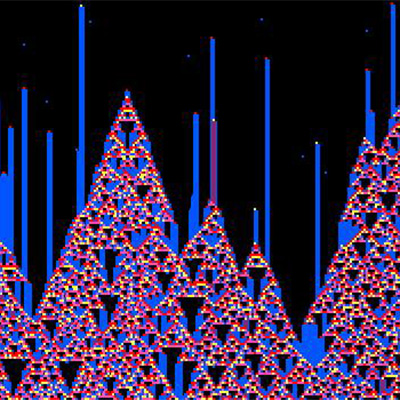
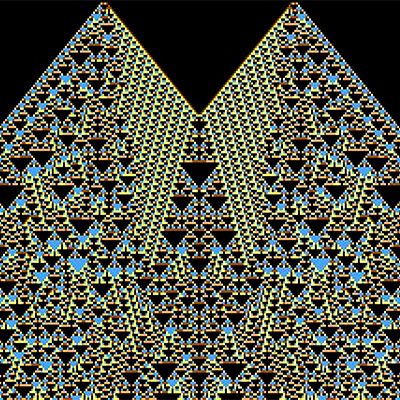
Nevertheless, one can of course attempt to develop conceptual models to at least work out possible explanations—and that is precisely what Franke delivers in The P Principle. To develop his concept of a “computing space,” which stems from Zuse’s idea, he draws on the most important models developed to date: In addition to the difference between classical and quantum physics, which he explains in detail, he draws on fractal mathematics and the increasingly significant field of information theory, for example. As already mentioned, in connection with the principle of iteration—which, as is well known, underlies fractal geometries—Franke refers to so-called cellular automata. He proposes using cellular automata to simulate the overarching universal system in which the laws of nature could be embedded.
The P-Principle: an Information-Processing System
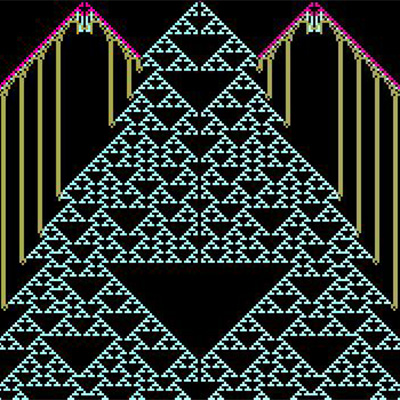
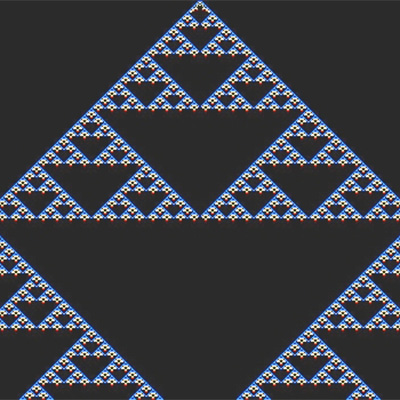
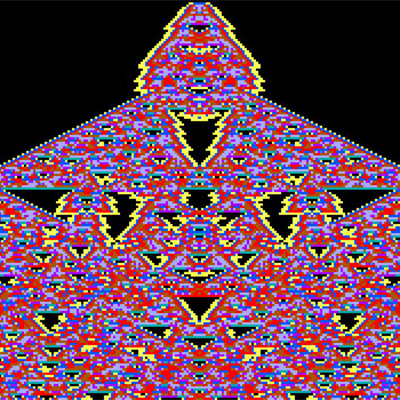
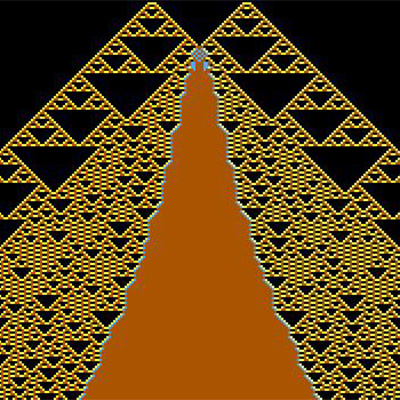
However, there are a few things to keep in mind during programming: If the initial parameters are too narrow, too deterministic, the development of the system arising from the simple formula would quickly run into a dead end: Nothing new could emerge. While complexity would steadily increase, it would produce nothing more than an ever-growing number of triangles, whose creative scope for generating truly new forms is very limited. In this case, nothing new would emerge; the development of such a system would eventually end in chaos. Or it would be—as Franke explains using other examples of cellular automata—“not durable” and not sufficiently consistent or “stable” to enable a continuously running program. Franke writes:
Viewed from the perspective of information theory, there is a significant reduction in complexity with each step to a higher level. This is because the newly introduced units, such as atoms, molecules, or cells, can be assumed to be stable. One no longer needs to take into account the possibility of their being destroyed or altered—perhaps with the expenditure of higher energy—but can assume them to be fixed and unchanging. In a manner of speaking, the combinations then start over on a new level, building up to a new level of complexity. Independent rules can be formulated for the interactions possible at the various levels, and these do not necessarily have to derive from those that apply to the other levels. [5]
According to the model of cellular automata described by Franke, it would also be possible to explain why the universe does not necessarily have to die the infamous heat death—a claim of the so-called Standard Model of Cosmology that has already been questioned by some renowned scientists: Because there is no linear increase in complexity; rather, the universe could be a non-linearly and dynamically evolving “system” that prevents entropic death through regular reductions in complexity at higher stages of development. If we take this concept into account—that is, in conjunction with the principle of iteration and fractal mathematics—the singularity at the beginning of the universe—assuming it actually had one—could have been a so-called attractor or strange attractor, in which the possible/probable “worldlines” converged and became energetically condensed—with those possibilities being “selected” that then led to a persistent universe capable of a stable evolutionary history over extremely long periods of time. The initial parameters of the universe could thus have been determined insofar as they brought it into existence in the first place—which, however, does not necessarily mean that all developments within it proceed in a deterministic manner.
As one engages in such and similar reflections, it is inevitable that the question of the origin and nature of human consciousness and thought will eventually arise. According to the Penrose/Hameroff model of consciousness—developed by mathematician, theoretical physicist, and Nobel laureate Roger Penrose in collaboration with anesthesiologist Stuart Hameroff—consciousness could be a kind of boundary phenomenon that arises at the boundary between quantum and classical physical space, or in other words: at the boundary between nonlocality and locality. Penrose first published the theory in his 1994 book Shadows of the Mind. According to this model, the collapse of the wave function—the source of our consciousness—takes place within the cavities of tiny, cylindrical tubes called “microtubules,” which are found in large numbers in the nerve cells (neurons) of our brain. In this sense, a constant updating of our consciousness would take place at this interface—driven by the steady influx of information from our natural environment. Or, in the language of the computer or programming paradigm: The classical physical world we experience could provide the check bits that the qubits “read out” at the boundary of the non-local source of our consciousness, thereby converting them into “localized” empirical experiential content. A fascinating idea!
Questions of this kind could also help to bridge—or at least narrow—the supposedly unbridgeable gap that has emerged between the humanities and the natural sciences over the past few centuries, and to reconcile the two fields: scientific work is the attempt to understand the processes, phenomena, and laws of nature. To do this—as is obvious enough—requires the mind, conscious thought. And that is where the humanities come into play. Both fields could inspire one another and lead to fruitful results, especially in light of the question of whether the mind-matter dualism can even be maintained in its current form. Let us conclude by returning to “Computing Space” and cellular automata. Since the Big Bang theory has certain explanatory shortcomings, many other models have naturally been proposed since its inception to fill these gaps. One of them is the so-called “CBU.” The acronym stands for Continuously Breeding Universe—meaning a universe that continuously “breeds”—which implies that it constantly creates and multiplies new forms in an ongoing process. This is precisely where the connection to cellular automata lies, for the CBU starts from a simple initial condition that then leads to increasingly complex form [6].
Die Welt ein Automat?
Herbert W. Franke had also posed this question in a previously unpublished 2016 manuscript titled The Universe—An Automaton? [6] Perhaps all these theories regarding the origin of the universe are partial expressions or, as Bohm wrote, abstractions of certain manifestations “that are relevant in a certain context.” Perhaps they are fragments, theoretical “shards” in a vast, ever-shifting kaleidoscope of the mind, which “experiments” with itself in different forms and attempts to discover and “fathom” itself.
And who knows?—perhaps we are not even destined to find a definitive answer to all these questions. Perhaps there is no universal theory, no fundamental world formula with which everything in the universe could be brought under a single theoretical umbrella. Perhaps it is precisely the openness of this intellectual process, its ongoing development and refinement, its vitality, that best describes the essence of our existence. Herbert W. Franke’s book Das P-Prinzip. Naturwissenschaftliche Gesetze im Rechnenden Raum makes an important and valuable contribution to this. It combines scientific findings with questions of natural philosophy, thereby joining the ranks of the metaphysical writings of great physicists and mathematicians. Anyone seeking information outside the scientific orthodox, which all too often tends toward dogmatic rigidity, will surely find many inspiring thoughts within its pages.
[1] Zuse, Konrad: Rechnender Raum, Schriften zur Datenverarbeitung, Band 1, Vieweg, Braunschweig 1969. (Calculating Space)
[2] Editor’s note: Franke was an avowed agnostic, but he explored the question of a divine authority in several novels and short stories. In his view, it is the task of science fiction authors not only to offer a fantastical sense of wonder, but also to present possible models of the future based on modern science and technology. More on these aspects can be found in the scholarly commentary Herbert W. Franke’s P-Principle and his Science Fiction by literary scholar Hans Esselborn in this volume.
[3] Editor’s note: Franke presents Bohm’s ideas in the chapter Matter as a Wave in The P-Principle. Despite similarities in their approach—such as reformulating the theory to gain a better understanding of matter waves—Franke’s perspective was fundamentally different. Bohm’s goal was to arrive at a deterministic model of the world in this way, whereas Franke started from a non-deterministic worldview in which genuine randomness operates through quantum processes. See also the paper A Flow Model of Wave Mechanics from 1954, published in English for the first time in the uopcoming volume The P-Principle Edition Herbert W. Franke 3 of Deutscher Kunstverlag, Berlin.
[4] Heisenberg, Werner: The physicist’s Conception of Nature, Hutchinson Scientific and Technical, London 1958, p. 28-29.
[5] See Herbert W. Franke: Das P-Prinzip, Insel 1995, p. 300-301.
[6] Editor’s note: The manuscript has now been published for the first time in Susanne Päch (Ed.), Art and Construction, Edition Herbert W. Franke 1, Deutscher Kunstverlag, Berlin 2026.
.